


Gold
—









%0A$4,568.82/oz%20(down%20~$51,%20-...)
Gold Holds Near $4,600 as Markets Go Thin on May Day — What Physical Buyers Should Know
FRIDAY, MAY 1, 2026 · ATLANTA, GA
ALEX LEXINGTON
THE DAILY MARKET INTELLIGENCE EDITION
---
MARKET SNAPSHOT
| Gold Spot (XAU/USD) | $4,568.82/oz (down ~$51, -1.1% from prior close) — New York extending London's softness on a holiday-thinned tape; testing the lower edge of April's $4,548–$4,825 range |
| Silver Spot (XAG/USD) | $73.60/oz (down ~$0.44, -0.6% from prior close) — holding relatively firm versus gold; ratio compression intact from the April 16 trough of 59.77 |
| Gold/Silver Ratio | 62.6:1 — well below the 80 historical norm; silver remains historically rich versus gold on a relative basis |
| Brent Crude | $110+/bbl (intraday spike to $114.66 on contract expiry) — Strait of Hormuz disruption premium sustained; EIA projects Q2 peak near $115 |
| DXY (US Dollar Index) | 98.15 — firm but still below the 100.26–101.14 key resistance band; dollar pressure capping gold rallies |
| 10-Year Treasury Yield | 4.39% — elevated; non-yielding gold faces opportunity cost in the current rate-channel-dominant regime |
| S&P 500 (SPY) | $715.67 (April 30 close) — equities firm, risk-on intact; today's May 1 intraday not yet confirmed |
| VIX | 17.10 (down 9.10% from prior close) — well below the 20 stress threshold; no broad risk-off deleveraging in play |
China (SGE) and India (MCX) are both closed today for May Day. The world's two largest physical gold-consuming markets are absent from today's tape. London opened mildly soft at $4,614.98 before New York extended the decline to $4,568.82 by mid-session — a confirm-and-extend pattern on a tape missing its primary physical-demand anchors. GLD closed April at $419.05; SLV at $66.66. The spot-to-ETF divergence that defined April — North American ETF outflows running alongside physical accumulation in the East — continues into the first session of May.
The macro backdrop behind today's softness is the same force that capped gold through the second half of April: the inverted oil-gold correlation regime. With Brent above $110 and the EIA flagging a Q2 peak near $115, the standard "oil up equals gold up" logic breaks down. When oil spikes, the Fed sees inflation and holds rates higher for longer. The Treasury market responds by bidding the dollar and 10-year yield. Non-yielding gold faces rising opportunity cost. UBS analyst Giovanni Staunovo named the mechanic explicitly this week: gold "remains negatively correlated to oil in the short term, as it impacts interest rate expectations." The Fed's April 29 hold at 3.50–3.75% — with the most dissenting votes at any FOMC meeting since 1992 — confirmed the rate-channel dominance is not fading soon.
---
MARKET CONTEXT
First business day of May is not a normal Friday. Two of the world's four major precious metals price-discovery centers are closed for Labour Day. What remains is a partial print: thin Asian volumes, a mildly offered London open, and a New York session extending the softness on below-average participation. The price on your screen today is real. It is not a full-market price.
No Shanghai Gold Exchange premium signal today. No MCX physical-demand read from India. The Asian physical bid floor — which provides an important structural support for gold during periods of Western paper selling — is dark until Monday.
That is the single most important context for interpreting today's $4,568 gold print. The absence of buyers is partly structural (rate-channel headwind) and partly mechanical (holiday closure). Monday's Asian session, and specifically the SGE premium structure when Shanghai reopens, will be the first clean read on whether Eastern buyers are absorbing Western outflows at current prices or whether the structural floor is softening. That is the data point that matters most for the opening week of May.
The Fed backdrop is in full view. Last Tuesday's FOMC delivered an 8-4 hold with the most internal dissent since 1992. Governor Miran voted for an immediate 25-basis-point cut. Hammack, Kashkari, and Logan held but pushed back on easing-bias language. The Fed statement explicitly cited "Middle East developments contributing to a high level of uncertainty" — the Hormuz disruption's direct entry into the rate-path calculus. CME FedWatch now prices approximately 70% probability of a hold at the June 16–17 meeting and 77.5% probability of no rate change at all in 2026. The rate-cut tailwind that carried gold from $2,600 in late 2024 to the January peak near $5,238 is now priced as effectively gone for the calendar year.
It does not remove the structural floor. The People's Bank of China extended 17 consecutive months of reserve buying to a record 2,313 tonnes. Central banks globally purchased 244 tonnes in Q1 alone — a 3% year-over-year increase with a 74% jump in dollar value on price appreciation alone. The Perth Mint reported "unprecedented bullion demand" and continues order size limits on 1-kilogram silver bars and coins. The Swiss National Bank held its 1,040-tonne gold position explicitly neutral. Sovereign accumulation logic operates outside rate-path math — it moves on currency-debasement and reserve-diversification logic that plays out over decades, not FOMC meeting cycles.
On silver, the story is incrementally better. The gold/silver ratio at 62.6:1 remains near the April 16 trough of 59.77, meaning silver has outperformed gold on a relative basis throughout the entire month of April. The Silver Institute projects a 2026 supply deficit of 46.3 million ounces — the sixth consecutive deficit year — with cumulative above-ground drawdowns exceeding 762 million ounces since 2021. Solar manufacturing and EV battery contact demand provides an industrial anchor that is not rate-sensitive the way investment demand is. Silver's -0.6% on the day versus gold's -1.1% is a small but visible confirmation of that relative strength.
---
MAVERICK TRADING JOURNAL
No new call today. No signal fired.
The three-layer signal check found nothing actionable on either metal. Gold's weekly decline of approximately 1.2% to 2.0% is below the 2.0–3.5% mean-reversion trigger threshold. Yesterday's powerful +2.24% rebound on April 30 already consumed the contrarian long opportunity off the multi-day low. Today's partial reversal does not re-establish a clean entry. Silver's weekly move of approximately 1% is well below the 4.0–6.0% silver signal threshold.
The SLV BUY from March 31 at $64.03 remains open. At today's $66.66, that position carries a +4.11% gain — rebuilt from the April 30 compression that briefly pushed it toward +1.27% intraday. The structural thesis behind that position is intact: the Silver Institute's documented supply deficit, CFTC silver speculative positioning at only 23,720 net long contracts (historically thin, not crowded), and Perth Mint reporting historically elevated monthly silver coin and bar sales with order size limits still in place. The position is flagged for Andre's close review. It has been open 31 calendar days. The decision to close or carry forward is Andre's per the rules.
The GLD BUY from April 2 was stopped out on April 28 at $418.85, logging a -4.33% loss. Today's GLD print of $419.05 sits essentially at the close-out level — a confirmation that the stop discipline captured the right price, even if the outcome was painful. No re-entry per Rule 5D while post-event variance remains elevated. The next clean gold setup depends on Monday's Asian session read and the May 8 NFP print.
No trade today. Sometimes the most disciplined position is no position.
---
THE TAKEAWAY
For physical buyers at Alex Lexington, the ACCUMULATE GRADUALLY posture carries into May.
Gold at $4,568 sits approximately 4.7% below the April high of $4,825 and roughly 12% below the late-January peak near $5,238. On a normal trading day with full Asian participation, a 4.7% pullback from a recent high inside a multi-year structural bull market would qualify as BUY WINDOW OPEN territory — the kind of level where the physical counter sees consistent buyer interest. Two factors temper the urgency today. First, a thin holiday tape makes today's price print less reliable as a fair-value reference — the market is missing its two largest physical-demand anchors. Second, North American gold ETF outflows ran -$12.7 billion in March and approximately -$1.5 billion in early May. Institutional paper selling can extend the pullback further before it stabilizes.
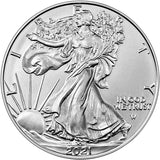
The practical read for DCA buyers: do not pause. A 1-ounce American Gold Eagle, Maple Leaf, or Krugerrand at gold spot near $4,600 plus typical $120–$180 dealer premiums puts all-in cost at roughly $4,720–$4,780 per coin — a meaningful discount to mid-April's peak and well within the range where cost-averaging makes structural sense. Buyers who want to time a tactical entry more precisely should wait for either a confirmed break below $4,500 on a hot NFP data print — which would represent a clean BUY WINDOW OPEN signal — or Monday's Asian session confirming that Eastern buyers are absorbing Western outflows at current levels.
For silver stackers, the structural case is stronger today than the gold case. Spot $73.60 plus $3–$5 generic bullion premium places 1-ounce coins and 10-ounce bars all-in between $76.60 and $78.60 per ounce — well below April's $80 peak and with a six-year supply deficit tailwind that gold does not share. CFTC positioning at only 23,720 net speculative long contracts is historically thin, meaning the current softness reflects industrial-demand caution and dollar/yield pressure rather than a crowded speculative unwind. When those headwinds rotate, silver typically moves fast.
We have been on this floor since 1977. The rate cycles change. The oil shock premiums eventually normalize. The Fed chairs rotate. What has not changed is that the buyers who kept systematic physical accumulation programs running through uncertain macro periods ended up holding metal at cost bases that look conservative in hindsight. The structural floor — central bank buying, supply discipline, currency debasement trajectory — ultimately dominates the cyclical rate-path noise.
Monday's SGE premium structure is the first clean May data point. May 8 NFP is the first binary macro catalyst. Kevin Warsh takes over as Fed chair on May 15 — the most asymmetric event on the monthly calendar, with the potential to violently reprice the market's 77.5% probability of no rate change in 2026 if his first public statement leans dovish.
---
DISCLOSURE
This content reflects disclosed trading activity and market analysis for educational purposes. Alex Lexington does not manage client funds or provide personalized financial advice. Past performance does not guarantee future results. Always consult a licensed financial advisor before making investment decisions.---