


Gold
—










%0A$4,117.00/oz%20(down%20appr...)
Silver and Gold Extend Losses as Dollar Presses 13-Month High — PCE Thursday Is the Only Number That Matters
TUESDAY, JUNE 23, 2026 · ATLANTA, GA
ALEX LEXINGTON
THE DAILY MARKET INTELLIGENCE EDITION
---
MARKET SNAPSHOT
| Gold Spot (XAU/USD) | $4,117.00/oz (down approximately $76, -1.8% from prior close) — intraday low of $4,090.10 during London-to-New York handoff; nearly two-week low; -26.5% from the January 28 all-time record of $5,608.35 |
| Silver Spot (XAG/USD) | $65.20/oz (down from prior close of approximately $66.42–$66.82, -1.8% to -2.4% on the session) — intraday range $65.20–$69.71 signals whipsaw volatility rather than clean directional trend; -46% from January peak of $121.62 |
| Gold/Silver Ratio | 63.0:1 — mid-band neutral territory; above 80 is where patient ratio-stackers historically find the deepest accumulation windows; ratio has moved off its spring extremes but is not yet at the actionable threshold |
| Brent Crude | $76.68/bbl (down $0.84, -1.07% from prior close) — Iran 60-day oil export license continuing to unwind the geopolitical safe-haven premium; soft energy reduces the inflation-fear channel that would otherwise support metals |
| WTI Crude | $73.67/bbl (down $0.19, -0.26% from prior close) — corroborates the Iran-peace-unwind thesis; both crude benchmarks confirm softer energy is not providing a bullish inflation-channel offset for gold today |
| DXY (US Dollar Index) | 101.32 — within two points of the 52-week high of 101.34; the primary mechanical suppressor of both metals; dollar at a 13-month high is the real-yield arithmetic in action |
| 10-Year Treasury Yield | ~4.48% — elevated on hawkish-Fed repricing; real-yield pressure on non-yielding gold remains structurally intact |
| S&P 500 (SPY) | $744.39 (down $2.35, -0.32% from prior close; intraday range $743.13–$750.18) — equities absorbing the hawkish Fed as a rate-channel revision, not a systemic-risk event; the equity-metals divergence is diagnostic |
| VIX | ~17.48 — below the 20 stress threshold; no safe-haven channel firing; metals selling on rate mechanics, not panic |
Asia set the directional tone overnight, with gold sliding from $4,150 early in the session to the $4,115 region before the London open. The London session did not reverse the Asian bias — it confirmed and accelerated it, with the Dollar Index pressing toward 101.32 and the session low printing at $4,090.10 during the handoff to New York. The Shanghai Gold Exchange Au99.99 premium compressed sharply to approximately +0.11% over COMEX — down materially from the +3.5 to +4.0% readings posted as recently as June 20. COMEX open interest ran approximately 101,450 contracts per cross-reference data, consistent with position adjustment ahead of Thursday's PCE release. Global gold ETF assets under management stand at approximately $383 billion after H1 2026 net inflows of $38 billion, the strongest semi-annual ETF performance since H1 2020 per the World Gold Council — institutional money remains positioned structurally, even as the tactical tape adjusts to the policy repricing.
---
MARKET CONTEXT
Five trading sessions in, the post-FOMC hawkish repricing has the floor.
The June 17 Dot Plot revision — nine of 18 Fed officials now projecting at least one rate hike in 2026, median dot shifted to 3.8% — was the original catalyst. What followed is textbook rate-channel behavior in precious metals: dollar strength compresses the real-yield argument for holding non-yielding gold, speculative positioning adjusts, and the selloff compounds itself until a policy-inflection catalyst breaks the configuration. The CFTC's most recent Commitments of Traders data show managed money gold net longs declining to 173,800 contracts — still elevated in absolute terms, but the direction of travel is down and position-cleansing is in progress. BofA and Deutsche Bank both formally added a September rate hike to their base cases this week.
The cross-asset picture is internally consistent. DXY at 101.32 is pressing within two points of a 52-week high, with technical signals aligned across daily, weekly, and monthly timeframes. The 10-year Treasury yield at approximately 4.48% reflects a market pricing material probability of a September hike. The S&P 500 at $744.39 is absorbing all of this without panic — equities are treating the FOMC revision as a rate-path adjustment, not a crisis trigger. Gold, as the asset most directly exposed to real-yield mechanics, takes the hit. The VIX at 17.48 confirms the diagnosis: this is rate-channel pressure, not safe-haven liquidation.
The most important signal in today's session is not in the headlines. It is the Shanghai Gold Exchange premium compression.
The SGE Au99.99 premium over COMEX ran at +3.5 to +4.0% as recently as June 20. This morning it sits at approximately +0.11%. That compression represents a material reduction in Chinese commercial demand intensity — jewelry fabricators, regional dealers, and retail buyers are not stepping in aggressively at current levels. This matters because Chinese physical demand has been the structural price floor under every major gold pullback in this cycle. When the SGE premium is elevated, Chinese buyers are pulling metal into the country at a meaningful premium versus global benchmarks — that is a visible bid. When the premium compresses to near zero, the bid has stepped back.
The distinction between the SGE premium and PBOC accumulation is the educational point that most analysts miss. The People's Bank of China added 9.95 tonnes to reserves in May — the 19th consecutive month of buying and the largest single-month addition in 16 months per the World Gold Council, bringing total reserves to approximately 2,331.5 tonnes. PBOC accumulation is strategic. It operates on a multi-decade allocation target, not a day-to-day price signal. The SGE premium reflects shorter-cycle commercial Chinese demand, and that commercial bid is quieter today than it was last week. Both signals are real. They operate on entirely different transmission mechanisms, and conflating them produces the wrong tactical read.
Hong Kong continues to absorb physical metal regardless of the daily paper tape. Gold import volumes for the first five months of 2026 are up 76% year-over-year, approximately 692 tonnes, as the exchange captures routing share with its zero-VAT, zero-import-duty structure. Dubai added a new instrument on June 22: the DGCX T+0 Spot Gold contract, same-day AED settlement — physical market infrastructure deepening outside the traditional LBMA/COMEX axis.
India's market structure continues to shift in a direction worth noting. The 15% gold import duty — the largest single increase on record — has suppressed physical channel demand while simultaneously driving Indian gold ETF inflows to a record 20 tonnes in Q1 2026. The underlying appetite for gold has not diminished. It has changed its form.
Japan's BOJ raised its key rate 25 basis points to 1.0% in June — the highest since September 1995 — targeting energy-driven inflation. Rising JGB yields reduce yen carry-trade viability and create repatriation pressure on US Treasuries. USD/JPY at approximately 160.20 confirms the yen remains under dollar pressure despite the hike.
The ECB's June 2026 International Role of the Euro report confirmed that gold now represents 27% of global central bank reserves, overtaking US Treasuries at 22%. Central banks added 244 tonnes in Q1 2026 alone, above the five-year average per the World Gold Council. The Bundesbank holds 3,352 tonnes — the world's second-largest gold reserve — with approximately 37% stored at the New York Fed. German lawmakers renewed repatriation calls in January 2026 amid strained US-EU relations, though the CDU-led government and Bundesbank President Nagel have indicated no active reconsideration. The repatriation conversation, however, reflects something real: the global sovereign relationship with dollar-denominated custodial assets is under more scrutiny than at any point in a generation.
---
MAVERICK TRADING JOURNAL
Status: NO CALL — Monitoring
Three rule-based constraints converge today, and being explicit about all three is the point.
Rule 5B Layer 3 — multi-session trend-respect. When both the Asian session and the London session agree on direction for three or more consecutive trading days, the framework treats the move as a trend breaking out of oscillation rather than a mean-reversion opportunity. The instruction is unambiguous: do not fade it. Gold at $4,117 sits approximately -26.5% below the January 28 all-time high of $5,608.35. Under Layer 2 of the framework — multi-day swing analysis — that depth of drawdown would mechanically flag a LONG-side mean-reversion setup. But Layer 3 overrides Layer 2 when sessions are uniformly aligned. Asia sold. London confirmed. The US session has not provided a counterbalance. This is now the fifth consecutive session in the all-sessions-agree-DOWN configuration. The rule holds: respect the trend, suppress the counter-trend entry signal.
Rule 6 — open SLV BUY from March 31. The SLV ETF position opened at $64.03 now sits at $58.91 — approximately -8.0% unrealized, deteriorating from Friday's -5.7% read. The underlying structural thesis remains intact: a sixth consecutive year of silver supply deficit, a 2026 projected shortfall of 46.3 million oz per the Silver Institute, three-exchange inventory declines of approximately one billion troy ounces since 2021, and an industrial demand floor representing roughly 55 to 60% of annual consumption. The thesis has not broken. But Rule 6 is categorical: while a silver-side derivative position is open, no fresh silver derivative entries are permitted. Andre's close decision is live.
PCE Thursday — event-risk asymmetry. May Personal Consumption Expenditures data from the Bureau of Economic Analysis releases Thursday, June 25. Wells Fargo projects +4.1% YoY versus April's +3.8% reading — the Fed's preferred inflation gauge printing into a market already pricing approximately 70% probability of at least one rate hike by December per CME FedWatch data. A hot print compounds the multi-session-DOWN trend and extends mechanical real-yield pressure toward the $4,000 psychological floor. A soft print — call it 3.6% or below — breaks the configuration, softens the September hike narrative, and re-opens the Layer 2 mean-reversion signal that Layer 3 is currently suppressing. Any fresh directional position opened today faces that binary before any reasonable take-profit window can develop. Rule 5E does not technically bind at 48 hours out, but the event-risk arithmetic is not subtle.
The setup that re-engages a tactical call is one of four: a clean intraday Layer 1 fire — gold extends -2.0 to -3.5% from the session open in a single clean directional move; a soft PCE Thursday print that breaks the multi-session-DOWN configuration; a session divergence break where the overnight Asian session prints UP and London does not reverse it; or Andre closing the open SLV BUY, which lifts Rule 6 and reopens silver-side entries.
Closed positions, for reference: GLD March 2026 -2.10%. GLD April 2026 -4.33%. GLD May 2026 -2.27%. GOLD spot LONG June 8 to June 9: entry $4,330, target exit $4,463.82, result +3.09% WIN. One win against three losses on closed positions — 25% win rate, updated monthly. The June 8 win came when the framework had clean Layer 1 alignment and Layer 3 in the bullish direction rather than fighting a multi-session-DOWN regime. The losses came from premature counter-trend entries. The data is honest about both.
---
THE TAKEAWAY
The tactical picture and the physical picture are not in conflict. They are the same information read on different time scales.
Tactically: the rate-repricing channel is the active regime. The dollar at a 13-month high, the 10-year Treasury at 4.48%, BofA and Deutsche Bank both projecting a September hike, PCE Thursday arriving as a binary catalyst — that is the immediate mechanical pressure on the daily tape. No counter-trend trade makes sense inside that configuration until Thursday delivers clarity or sessions diverge overnight.
For physical buyers: gold at $4,117 is approximately -26.5% below the January 28 all-time record of $5,608.35. Silver at $65.20 is approximately -46% below its January peak of $121.62. These are the deepest physical accumulation windows of 2026 on both metals.
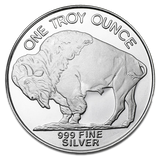
All-in cost on a 1-oz American Gold Eagle, Canadian Maple Leaf, Krugerrand, Britannia, or Austrian Philharmonic runs approximately $4,237 to $4,297 at current dealer premiums. A 1-oz American Silver Eagle runs approximately $70.20 to $72.20 all-in. Generic silver rounds and bars land slightly lower; 90% junk silver bag material offers the lowest per-troy-ounce premium in the product line.
The structural floor that supports those purchase decisions is not a trading signal. It is a multi-year composite: PBOC buying for 19 consecutive months with the largest single-month addition in 16 months in May. Central banks globally adding 244 tonnes in Q1 2026, above the five-year average per the World Gold Council. The ECB confirming gold has overtaken US Treasuries as the world's largest reserve asset — 27% versus 22% of global official reserves. H1 2026 gold ETF inflows of $38 billion, the best semi-annual result since H1 2020. A sixth consecutive year of silver supply deficit projected at 46.3 million ounces. Hong Kong gold imports up 76% year-over-year for the first five months of the year.
None of that eliminates price risk. Gold can decline further from $4,117. A hot PCE print Thursday could push toward the $4,000 psychological floor. But a 1-oz coin in segregated vault storage is exposed to the same structural demand dynamics — sovereign accumulation, ETF inflows, supply deficits, physical routing flows — that operate on a horizon measured in years, not Dot Plots.
For DCA customers running scheduled intervals, today's session represents the deepest gold price level of the quarter and a meaningfully deeper silver level versus mid-June — consistent with the logic of a dollar-cost averaging approach. Whether to continue at your standard interval, accelerate, or hold steady is your decision to make. For tactical buyers waiting for a cleaner entry, PCE Thursday is the catalyst to watch. A soft print is the policy inflection the market has been waiting for since June 17. A hot print deepens the window further and brings the $4,000 level into play as a potential secondary entry.
We have been in the Diamond District since 1977. Through every rate cycle, every geopolitical reordering, every Dot Plot revision. The structural bid — sovereign, institutional, industrial, physical — does not disappear because Fed officials move a projection. If you are thinking about entering the physical market or adding to existing holdings, the team at Alex Lexington is here to walk through coins, bullion, premiums, and vault storage options. The conversation is free. There is no pressure to act before Thursday's number. But there is no structural reason to wait years.
---
FORWARD OUTLOOK
The week has a single pivot point: May PCE, releasing Thursday June 25 from the Bureau of Economic Analysis. Wells Fargo's projection of +4.1% YoY versus April's +3.8% is the consensus lean. A print at or above that level extends the multi-session-DOWN configuration toward the $4,000 psychological floor in gold, with the DXY potentially clearing its 52-week high at 101.34. A print at or below 3.6% YoY is the policy-inflection catalyst — the moment where September hike probability softens, the dollar faces its first meaningful reversal pressure, and Layer 2 mean-reversion signals come back into play on both metals. Secondary signals to watch this week: the CFTC Commitments of Traders update releasing Friday (silver positioning specifically has been a data gap), overnight Asian session behavior for any evidence of session divergence breaking the all-sessions-agree-DOWN pattern, and SGE premium movement — a re-widening toward the +3 to +4% range would signal Chinese commercial demand stepping back into the dip. The DXY resistance test at 101.34 is the cleanest intraday signal to watch Tuesday and Wednesday ahead of PCE.
---
DISCLOSURE
This content reflects disclosed trading activity and market analysis for educational purposes. Alex Lexington does not manage client funds or provide personalized financial advice. Past performance does not guarantee future results. Always consult a licensed financial advisor before making investment decisions.
---