


Gold
—








%0A$3,871.10/oz%20(down%20$12.3...)
Silver Breaks Below $50 as the Dollar Hits a 19-Month High — Why We're Not Trading Today
MONDAY, NOVEMBER 16, 2026 · ATLANTA, GA
ALEX LEXINGTON
THE DAILY MARKET INTELLIGENCE EDITION

MARKET SNAPSHOT
| Gold Spot (XAU/USD) | $3,871.10/oz (down $12.30, -0.32% from prior close) — testing $3,850 Fibonacci support (38.2% retracement of the 2015–2026 advance); 13-month low territory; intraday range $3,832.20–$3,902.30 |
| Silver Spot (XAG/USD) | $47.60/oz (down $1.03, -2.11% from prior close) — broke decisively below $50 psychological floor; intraday range $47.03–$49.18; cumulative two-session decline of approximately -4.7% from Friday's $49.97 |
| Gold/Silver Ratio | 81.4:1 — one-year high; breaches the historical 80:1 "silver undervalued" threshold; widened sharply from Friday's 77.9 as silver dramatically underperformed gold today |
| Brent Crude | $94.88/bbl (down $0.96, -1.00% from prior close) — intraday rebound to $96.60 on Gulf tension; Brent -13.39% over past month despite the geopolitical premium |
| DXY (US Dollar Index) | 103.47 — 19-month high; 52-week high of 103.57 also set today; EUR/USD at fresh local low of 1.1012; dollar at highest level since April 2025 |
| 10-Year Treasury Yield | 5.14% — up 29 basis points across five sessions from 4.86% on November 6; real 10-year TIPS yield approximately 2.86%, a multi-year high |
| S&P 500 (SPY) | $749.60 (down $7.52, -0.63% from prior close) — modest equity softness accompanying the cross-asset hawkish rotation |
| VIX | 20.08 (up +3.21% from prior close) — sitting at the 20 stress threshold for the first time this cycle; intraday range 19.84–20.16 |
Gold has pulled back approximately 6.68% from last Monday's $4,148 peak — a move that now extends across five full sessions and puts the yellow metal at levels not seen since October 2025. Silver's break below $50 is the sharper story this morning: the $47.60 print places the Gold/Silver Ratio at 81.4, a one-year high that crosses the 80:1 threshold historically associated with silver undervaluation. COMEX gold December 2026 futures showed 151,010 contracts with open interest at 215,120 contracts as repositioning continued through the morning session. The GLD ETF closed Friday at $354.89 and shows $355.70 in today's session — still below the prior $358 stop level. The GLD ETF saw $1.53 billion in 30-day outflows, reversing October's $2.7 billion inflow month. The dollar's move is the dominant mechanical story: the DXY has gained 4.20% year-over-year, and EUR/USD printing a fresh low of 1.1012 reflects the speed at which the European side of this trade has deteriorated as well.
The rate picture is equally unambiguous. CME FedWatch data shows markets now pricing a 100% probability of a December rate hike — 90.8% for 25 basis points, 9.2% for 50 basis points — up from 89% a week ago. The 10-year real yield at approximately 2.86% is at a multi-year high, and that figure is the mechanical reason non-yielding metals face a persistent headwind: when you can earn real returns in Treasuries, the opportunity cost of holding physical gold rises. Five sessions, +29 basis points on the 10-year. That is a significant repricing in a short window.
MARKET CONTEXT
The session's macro configuration follows a straight line from last week's October data releases. CPI came in at +0.4% month-over-month against a 0.3% consensus; PPI printed at +6.5% year-over-year, the fastest annual pace since November 2022. Those two prints locked in the Fed's hawkish path through December and, increasingly, beyond. Fed officials from Kansas City, the Vice Chair's office, and Boston have all described inflation as "running too hot" in recent days. The market is not guessing at a December hike — it has priced one with certainty.
Into that environment, Fed Chair Kevin Warsh is scheduled to speak at 12:00 PM ET today at the Federal Reserve's AI and Productivity Conference. That is roughly three to four hours from when this article publishes. His comments could land anywhere on the spectrum. A hawkish lean from Warsh would push the 50-basis-point December probability — currently at 9.2% — toward the 15% territory the market has been actively testing, extending today's dollar and yield move. A dovish nuance, on the other hand, would likely trigger a sharp relief rally in both metals given how compressed they are: gold down nearly 7% from last week's high, silver below $50, the Gold/Silver Ratio at a one-year high, and CFTC speculative positioning on silver at the 4th percentile of its three-year range.
The international picture adds dimension that the domestic rate narrative alone does not capture. The People's Bank of China added 26 tonnes of gold in October — the 24th consecutive month of buying — bringing total declared holdings to 2,435 tonnes. World Gold Council data for Q3 2026 shows central bank buying of 321 tonnes, up 42% year-over-year, with 63% of estimated purchases going unreported. That unreported portion — 201 of 321 tonnes — is the more significant figure: sovereign buyers are accumulating gold at a pace that the public data materially understates. The Shanghai Gold Exchange physical premium sat at approximately +$25 per ounce above Western spot as of late last week, signaling that Chinese buyers remain active in the physical market even as Western paper-channel prices compress.
India's October data tells a layered story. Formal gold imports collapsed 62.6% year-over-year to $5.51 billion. But Bloomberg reported that illegal gold smuggling surged more than 1,500% in Q3, with 50 metric tons flowing through gray-market channels versus 3 tons a year ago. The formal-channel number tells one story; the gray-market number tells another. Structural demand does not appear to have disappeared — it has rerouted. The Indian government responded by cutting the CBIC tariff value effective November 14, which may partially restore formal-channel flows in the coming months.
Overseas session flows today showed the same pattern that StoneX and Forex.com have documented since September: Asian sessions absorbing weakness while London and US sessions deliver distribution. The cumulative net decline across London and US sessions since September stands at -14.7%. Asia bought the overnight dip this morning; London pressed lower through the EUR/USD move; and the US session has extended the distribution into the DXY breakout. The Dubai Precious Metals Conference runs today and tomorrow — no price-moving announcements from the opening session, but it anchors the Middle East physical-market infrastructure conversation for the week.
MAVERICK TRADING JOURNAL
We are not making a new trade today. That is not a hedge or a soft answer — it is the framework-compliant posture, and I want to be specific about why.
The GLD call we opened in June closed out on Friday at a 3.03% loss. Today is the first full trading session since that stop-out. The discipline here is straightforward: we do not immediately re-enter the same direction to try to recover. We wait for a fresh setup — a dip significant enough to generate a genuine entry signal, cleared of the event-risk that is specifically present today. That discipline exists because the most expensive trades in this business are the ones placed while chasing a recently closed position.
On silver, we have an open position from March that sits at a significant drawdown — spot reference is approximately 25.66% below our entry. That position remains open, pending a close decision. No new silver-side derivative entry can be added while that position is still live.
Those two considerations — gold-side discipline post-stopout, silver-side blocked by the open position — would be enough to keep us in cash today on their own. But the third and most decisive factor is the Warsh speech at noon. Fed Chair commentary in a regime where a December hike is fully priced, with a 50-basis-point tail that the market has actively tested, carries binary-adjacent risk. Neither direction of that trade can be sized intelligently before the speech. After it, with the event resolved and the market's reaction registered, the picture changes — but we write the brief in the morning, not the afternoon.
The structural picture remains what it has been. The PBoC has bought gold for 24 consecutive months. Central bank buying ran 42% above last year's pace through Q3. The Silver Institute projects a sixth consecutive annual supply deficit of 46.3 million oz for silver. CFTC speculative positioning on silver sits at the 4th percentile of its three-year range — not a timing signal on its own, but a configuration that historically accompanies turning points, not trend extensions. The Gold/Silver Ratio breaching 80 is the kind of structural reading that, over multi-week horizons, has historically resolved in silver's favor.
None of that is a reason to force a trade today. It is context for understanding the structural setup that will eventually generate the entry we are waiting for.
Gold at $3,871 represents the spot reference environment today. That is roughly where a 1 oz American Eagle, Maple Leaf, or Krugerrand is priced before dealer premium. The last time gold was in this range was October 2025. What the spot price does day-to-day is one thing; what it means for someone accumulating physical metal over months and years is another. Those are two separate conversations, and today the spot conversation and the structural conversation point in genuinely different directions.
THE TAKEAWAY
The week opens with clarity on one thing: the derivative channel and the physical channel are operating on different clocks. The derivative channel — ETFs, futures, paper positioning — is repricing in real time to 100% December hike probability, a 19-month dollar high, and a 10-year Treasury yield that has added 29 basis points in five sessions. That repricing is legitimate, and Friday's stop-out was the cost of holding through it.
The physical channel tells a different story. Gold down 6.68% from last week's high with the PBoC still buying every month. Silver at a one-year underperformance extreme with six straight years of supply deficits on the books. The gap between where the paper price trades today and where the structural demand picture points over a multi-year horizon is wider than it has been at most points this cycle.
The Warsh speech at noon is the near-term binary. Post-speech, with the Fed Chair's signal registered, the question becomes whether the market's reaction generates the entry conditions we need — a pullback significant enough to trigger a fresh signal, with sentiment and price moving in a coherent direction. If it does, we will be positioned to act. If it does not, we wait for the next opportunity.
The spot reference frame today — $3,871 on gold — is one data point in a longer accumulation picture. What that number means over months and years is a separate question from what the derivative channel is doing this morning. The three-generation perspective this business was built on — our family has been in this industry since 1977, through every rate cycle, every inflation wave, every dollar spike — consistently returns to one observation — not a guarantee, but a pattern worth holding as context: the derivative channel and the physical channel eventually re-converge. The timing of that convergence is what we watch for. Today we are watching.
FORWARD OUTLOOK
The week's key inputs begin at noon today when Warsh speaks. Wednesday brings Fed minutes from the November 4-5 FOMC meeting, which will be parsed for any dissent or dovish language the market has not priced. The December 8-9 FOMC decision is 23 days out and represents the binary resolution of the full hawkish-repricing narrative. Any sequential softening in inflation data between now and December 8 — or any signal from Warsh or subsequent Fed speakers that the 50-basis-point probability is overpriced — represents the most probable path for a metals relief rally. The DXY at 103.47 and the 10-year at 5.14% are the two mechanical pressure points to watch; meaningful reversals in either would shift the near-term picture for gold and silver.
DISCLOSURE
This content reflects disclosed trading activity and market analysis for educational purposes. Alex Lexington does not manage client funds or provide personalized financial advice. Past performance does not guarantee future results. Always consult a licensed financial advisor before making investment decisions.---
Read more
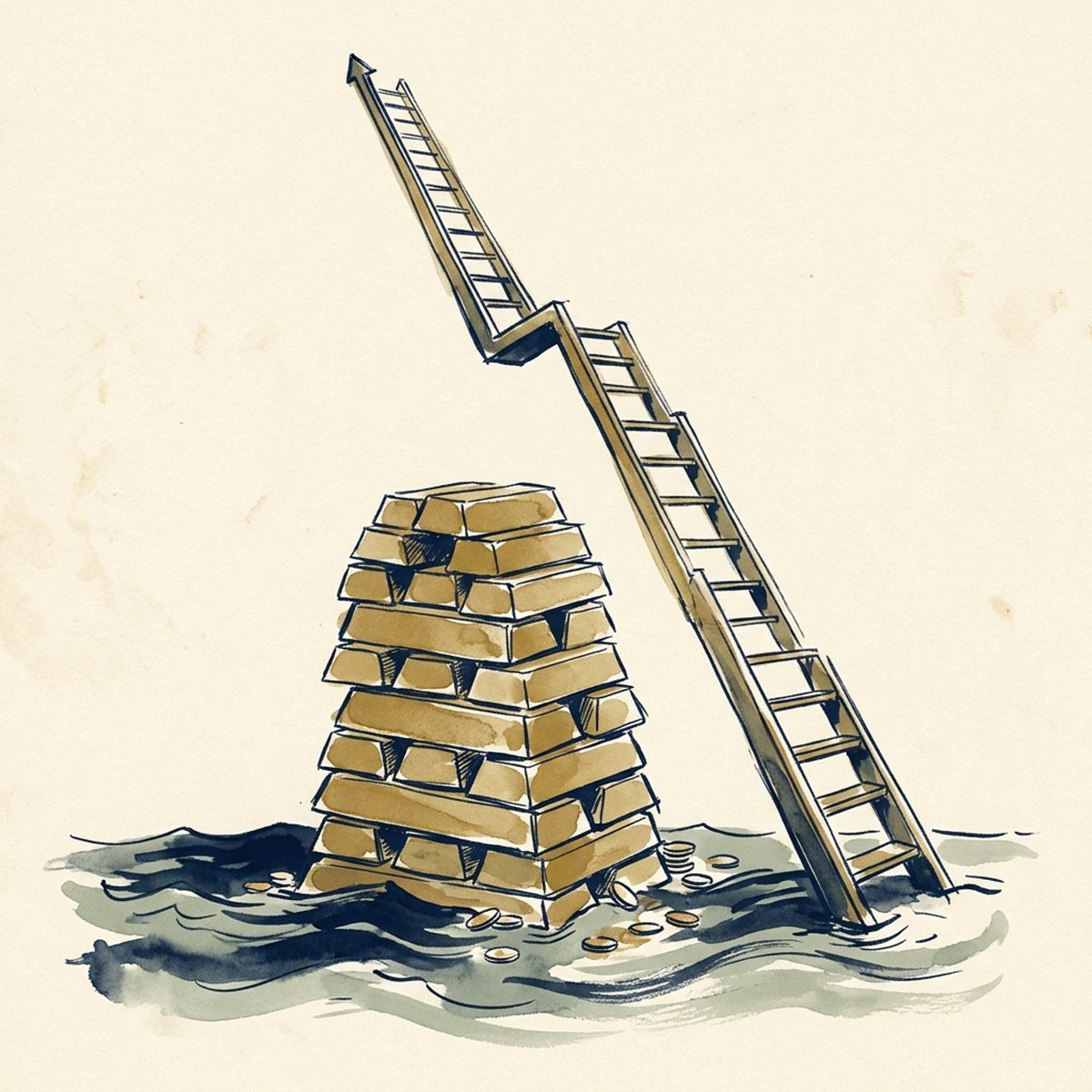
Week in Metals: Gold slides nearly 4% as rate-hike bets lift yields
Gold ended the week near $3,885, down nearly 4%, and silver fell about 4% as hot inflation data and Fed hike bets pushed the 10-year yield to about 5.15%. Central banks kept buying through the slide.
Read more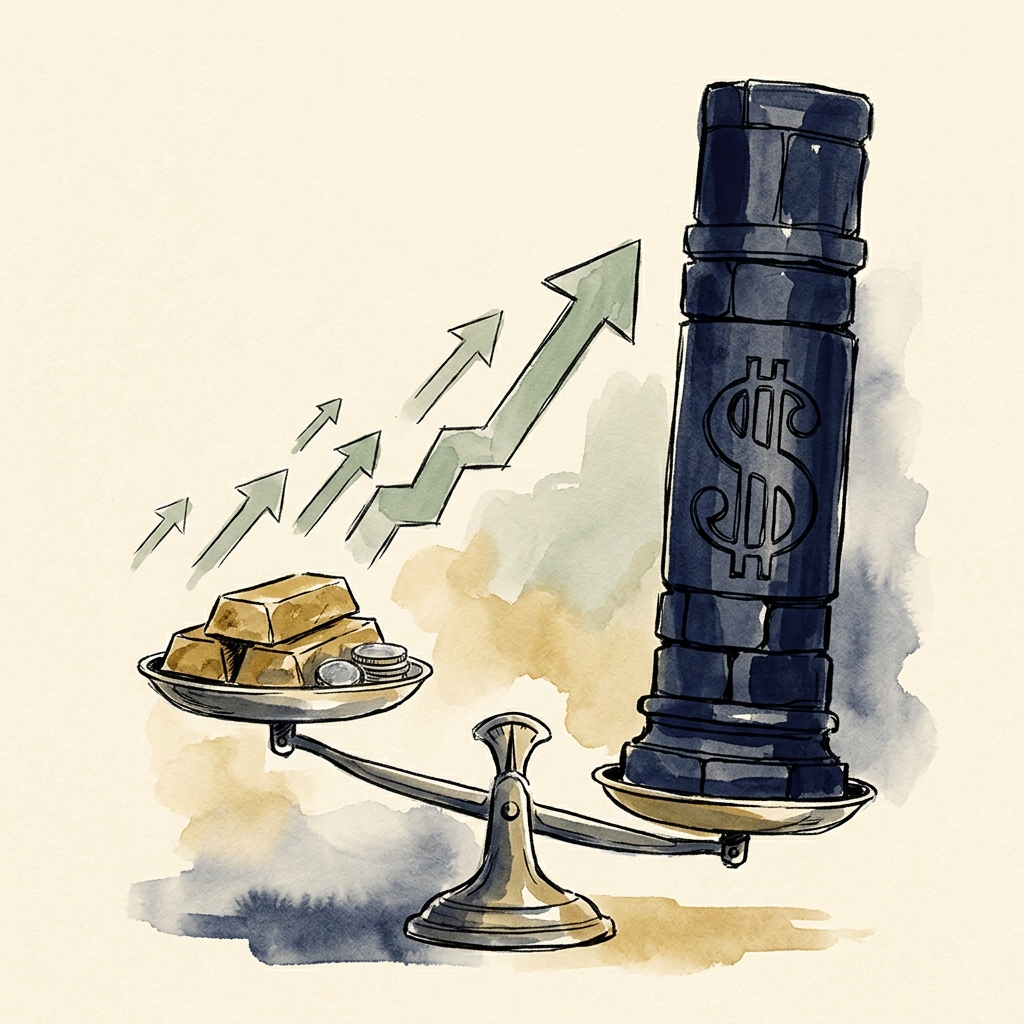
After the Bell: Gold hits a 13-month low as Fed hike bets lift the dollar
Gold slipped to around $3,856 and silver fell almost 4% as markets priced a December Fed rate hike and the dollar climbed. Here's what moved, what it means for borrowing, the pump and your metals, ...
Read more