


Gold
—


Article: The Hope Diamond 45 Carats of Curse, Crown, and the Reddest Glow in Gemology

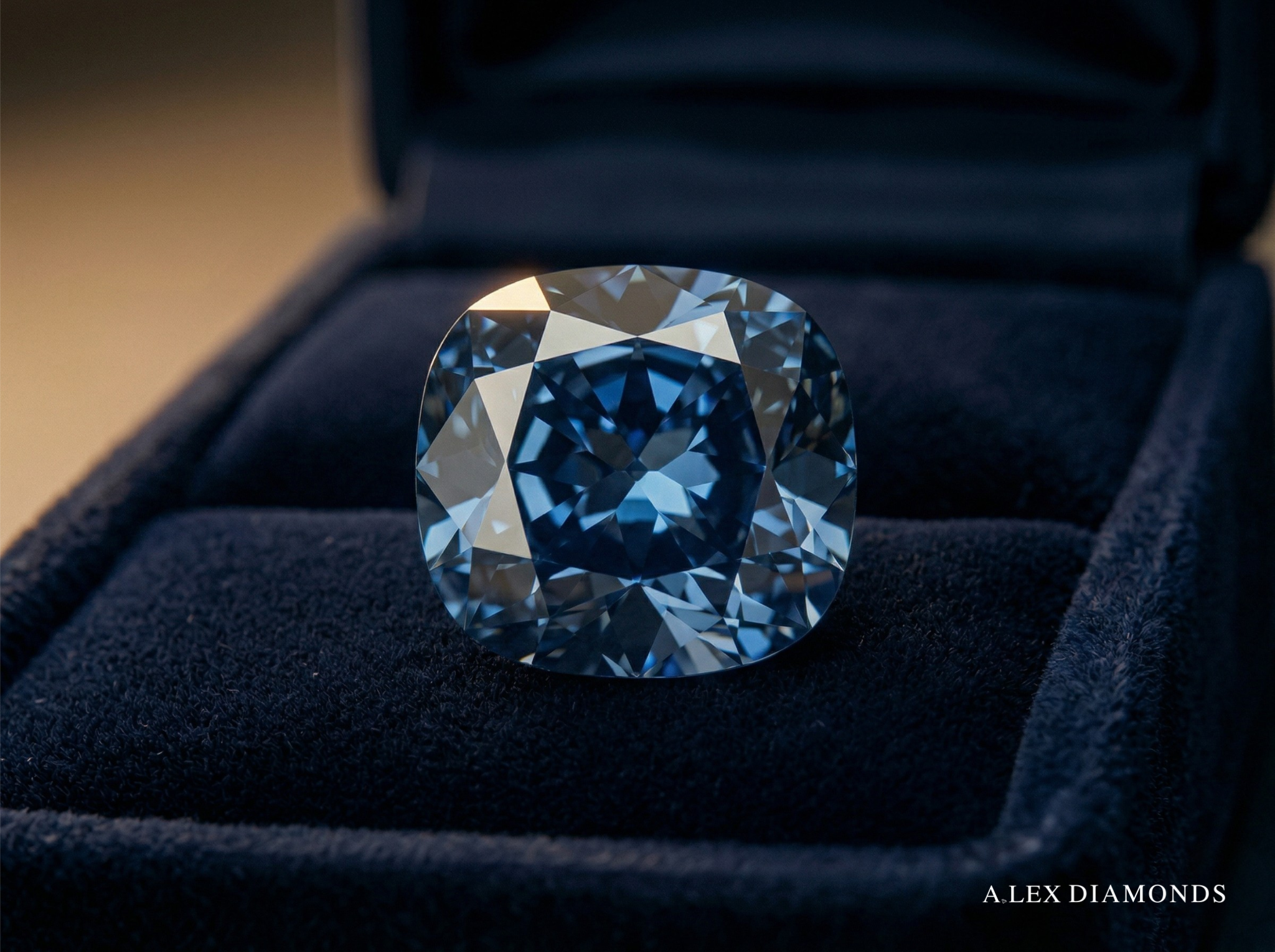
The Hope Diamond 45 Carats of Curse, Crown, and the Reddest Glow in Gemology
Diamond History
The Hope Diamond
45 Carats of Curse, Crown, and the Reddest Glow in Gemology
Pulled from a Golconda riverbed, sold to Louis XIV, stolen during a revolution, recut in the dark, cursed by legend, mailed to the Smithsonian in a brown paper package. The most famous diamond on earth earned its reputation the hard way.
April 2026 · Alex Lexington Editorial · 9 min read
The Facts at a Glance
45.52 Carats · Deep Blue
115 Carats Original · Tavernier Blue
1666 Year Acquired · Tavernier
30M+ Annual Visitors · Smithsonian
Full name: The Hope Diamond — previously the Tavernier Blue (115 carats), then the French Blue (67 carats), then the Hope after Henry Philip Hope's 1839 catalogue. Three names, three cuts, one stone
Cut: Cushion antique brilliant — recut at least twice. First by Sieur Pitau for Louis XIV (1673), then by unknown hands after the 1792 theft. The current 45.52-carat form has remained unaltered since
Color & Clarity: Fancy Dark Grayish Blue, VS1 — graded by GIA in 1988. The blue comes from trace amounts of boron in the crystal lattice, making it a Type IIb diamond — one of the rarest categories in nature
Origin: Golconda region, India — the same alluvial fields that produced the Florentine, the Koh-i-Noor, and the Regent. Purchased by Jean-Baptiste Tavernier in 1666
Current holder: The Smithsonian Institution's National Museum of Natural History, Washington, D.C. — donated by Harry Winston in 1958, sent via registered U.S. mail in a brown paper package insured for $1 million
Signature property: Under ultraviolet light, the Hope Diamond phosphoresces an intense red — a glow that persists after the UV source is removed. This red afterglow is a diagnostic feature of Type IIb diamonds and one of the rarest optical phenomena in gemology
Historical Reference · GIA
Grading the Hope Diamond — Gemological Institute of America
The definitive gemological assessment of the Hope Diamond. Weight: 45.52 carats. Color: Fancy Dark Grayish Blue. Clarity: VS1. Type IIb classification. Red phosphorescence documented. Originally published in Gems & Gemology, 1988.
Read the Full GIA Report →Origins
Where It Came From
In 1666, Jean-Baptiste Tavernier — the French gem merchant who saw more legendary stones in person than any individual in history — purchased a roughly triangular blue diamond of approximately 115 carats from the Golconda diamond fields in India. He described its color as a "beautiful violet." It was one of the largest blue diamonds ever found, and Tavernier knew exactly who would want it.
In 1668, he sold the stone to King Louis XIV of France for 220,000 livres — a sum that, along with other gems in the transaction, effectively funded Tavernier's retirement and his purchase of a barony. Louis XIV had the stone recut in 1673 by his court jeweler, Sieur Pitau, who reduced the 115-carat rough to a 67-carat heart-shaped brilliant known as the French Blue. The loss of nearly half the stone's weight was considered acceptable: what emerged was a deep, saturated blue of extraordinary intensity, and it became the centerpiece of the French Crown Jewels. It would remain in royal French hands for over a century.
The Hope Diamond has been cut three times. Each time it got smaller. Each time it got more famous. There is a lesson in that — and it is not about diamonds.
What makes the Hope Diamond scientifically extraordinary — beyond its size and color — is its chemistry. The blue color comes from trace amounts of boron incorporated into the carbon crystal lattice during formation, deep in the earth's mantle. This makes it a Type IIb diamond, one of the rarest classifications in gemology. Fewer than 0.1% of all natural diamonds are Type IIb. And the Hope's most dramatic property follows from that chemistry: when exposed to ultraviolet light and then removed from the source, the stone phosphoresces an intense, persistent red. It glows. Not blue, not green — red. The afterglow can last for several seconds in a darkened room. No other famous diamond does this. It is, in the most literal sense, the stone that keeps burning after the light goes out.

The Hope Diamond · 45.52 carats · Cushion antique brilliant · Fancy Dark Grayish Blue · VS1 · Golconda origin · Smithsonian Institution
Ownership Timeline
From a Golconda Riverbed to a Brown Paper Package
1666
Golconda, India — The Purchase
Jean-Baptiste Tavernier acquires a roughly triangular blue diamond of approximately 115 carats from the Golconda mines. He describes its color as a "beautiful violet." It is the largest blue diamond he has ever handled.
1668
Louis XIV of France — The Sun King's Jewel
Tavernier sells the stone to Louis XIV for 220,000 livres. Five years later, court jeweler Sieur Pitau recuts it into a 67-carat heart-shaped brilliant. It becomes the French Blue — the crown jewel of the most powerful court in Europe. Louis wears it on a ceremonial pin at his throat.
1749
Louis XV — The Order of the Golden Fleece
The French Blue is set into an elaborate pendant for the Order of the Golden Fleece — the most prestigious chivalric order in Europe. It hangs alongside the Regent Diamond on a pendant of red spinels and gold. This is the diamond at its most politically powerful: a statement of divine right.
1792
The French Revolution — The Theft
During the September Massacres, a mob breaks into the Garde-Meuble — the French royal storehouse — over five nights. The French Blue vanishes, along with most of the Crown Jewels. Louis XVI has already been imprisoned. He will be guillotined in January 1793. Marie Antoinette follows in October. The diamond disappears for twenty years.
1812
London — The Reappearance
A 45.52-carat deep blue diamond surfaces in the London gem market — precisely twenty years after the theft, the exact length of the French statute of limitations for stolen property. It has been recut from 67 carats to 45. Whoever held it during those two decades sacrificed a third of the stone's weight to make it legally unrecognizable. The timing is not a coincidence.
1839
Henry Philip Hope — The Name
The diamond appears in a published catalogue of the gem collection of Henry Philip Hope, a wealthy London banker. This is the first time it is documented under the name that will follow it forever. The Hope family holds it for decades, though it passes through inheritance disputes and financial difficulties that will later be woven into the curse narrative.
1911
Evalyn Walsh McLean — The Last Private Owner
Pierre Cartier sells the diamond to Evalyn Walsh McLean, an American mining heiress, for $180,000. Cartier, understanding his client perfectly, had embellished the curse stories to make the stone more alluring — McLean was drawn to the danger. She wore it everywhere for decades, through a life marked by genuine tragedy: the death of her son, the institutionalization of her husband, and the suicide of her daughter. Whether the curse was real or whether Cartier simply sold a stone to a woman whose life was already complicated is a question the diamond does not answer.
1949
Harry Winston — The Final Dealer
Harry Winston purchases the Hope Diamond from the McLean estate. He exhibits it on tour for several years, set in a necklace of 16 alternating pear-shaped and cushion-cut white diamonds designed by Pierre Cartier. Winston understands something that every previous owner missed: the diamond's value is not in wearing it. It is in showing it.
1958
The Smithsonian — A Brown Paper Package
On November 10, 1958, Harry Winston donates the Hope Diamond to the Smithsonian Institution. He sends it by U.S. registered mail in a plain brown paper package, insured for $1 million. The postage costs $145.29. It arrives safely. It has been on permanent exhibition at the National Museum of Natural History ever since — seen by more people than any other diamond in history. The curse, according to the Smithsonian's curators, appears to have gone dormant.
Why It Matters
The Diamond That Taught the World to Tell Stories
The Hope Diamond is the most visited museum object in the United States. More people see it each year than the Mona Lisa. And most of them come not because of its gemological specifications — which are extraordinary — but because of its story. The curse. The kings. The theft. The brown paper package. The Hope Diamond taught the diamond industry, and the luxury world more broadly, that narrative is a form of value.
The curse itself is almost certainly a marketing invention. Pierre Cartier crafted and embellished the stories when he was trying to sell the stone to Evalyn Walsh McLean in 1911, understanding that danger made the diamond more desirable, not less. Many of the specific claims — that Tavernier stole it from a Hindu idol, that every owner met a violent end — are fiction or exaggeration. But the narrative stuck, and it stuck because it filled a need. People want diamonds to mean something beyond their physical properties. The Hope Diamond proved that the story around a stone can be worth more than the stone itself.
But the Hope also matters for purely scientific reasons that are often overshadowed by the mythology. Its Type IIb classification, its boron chemistry, and above all its red phosphorescence make it one of the most studied diamonds in gemological history. The red afterglow — that eerie, persistent light that remains after the UV source is removed — has no equivalent among the world's famous stones. It is, arguably, the Hope Diamond's most important characteristic: a property that cannot be faked, cannot be manufactured, and cannot be replicated. In a market where narrative can be invented, the phosphorescence is the thing that is real.
The Alex Lexington Design Perspective
Why We Design This Way
The Hope Diamond is the hardest design subject in this series — not because of the stone, but because of the noise around it. The curse narrative, the celebrity ownership, the Smithsonian fame — all of it creates a dense layer of cultural meaning that a designer has to either engage with or cut through. Every jeweler who has touched this stone since Cartier has had to answer the same question: do you design for the myth, or do you design for the diamond?
The Alex Lexington answer is both — but separately. One setting honors the French royal chapter. One engages the curse mythology directly. And one ignores the stories entirely and designs for the stone's most extraordinary physical property: the red phosphorescence. Three settings, three relationships with the same diamond, three ways of answering the question that the Hope has been asking for 360 years: what am I, beyond the stories people tell about me?
The great jewelry houses of the world built their archives over generations. Every piece they designed, every stone they wrote about, every point of view they committed to — that accumulated record became their authority. We are building ours now.
The three settings below each respond to a different dimension of the Hope Diamond's identity. One honors the crown. One honors the curse. One honors the chemistry. Together, they represent the Alex Lexington position that a stone this complex deserves more than one answer.
Design Imagination · Alex Lexington
If the Hope Were Set Today
Three settings. Three dimensions of the most storied diamond on earth — designed by a house that believes the best response to mythology is precision.
 Setting I
The French Blue Pendant
Royal Provenance · Crown Authority
An homage to the diamond's longest and most powerful chapter: 124 years as the jewel of the French Crown. The 45-carat cushion brilliant is cradled in an elaborate gold bail of baroque scrollwork — flowing, organic flourishes rendered in 18kt yellow gold and encrusted with micro-pavé white diamonds that catch every angle of light. The bail is not minimal; it is intentionally ornate, evoking the gilded excess of Versailles, where this stone once lived. Below the Hope, a single deep red spinel hangs in a pear cut — the same stone type used in the original Golden Fleece pendant — providing the only warm accent against the saturated blue. The chain is a diamond rivière: a continuous line of graduated collet-set brilliant cuts in gold, each stone slightly smaller than the last, creating a rhythm of diminishing light that draws the eye inexorably to the center.
The design logic here is historical atmosphere through modern craft. The Golden Fleece pendant was destroyed when the French Blue was stolen — no one alive has seen the original configuration. This pendant does not attempt a faithful replica. Instead, it captures the spirit of Bourbon court jewelry: gold over platinum, ornamentation over restraint, the baroque conviction that more detail means more power. The red spinel pear drop at the bottom is the key gesture — a direct quotation from the 1749 original, a single element that connects this setting to the stone's royal chapter.

Setting II
The Curse Choker
Dark Mythology · Dangerous Beauty
The setting that engages the myth directly. The Hope Diamond mounted at the center of a rigid black rhodium-plated platinum collar — the darkened metal absorbing light rather than reflecting it, creating a visual void against which the blue diamond burns. But the drama here is in the layers. The Hope sits at the heart of a concentric mandala: an inner ring of blood-red Burmese rubies pressed tight against the stone, a middle halo of pear-shaped white diamonds radiating outward like petals, and an outer scalloped border of black diamonds that frames the entire composition in darkness. The effect is almost floral — a lotus opening from a void. Rubies continue along the inner edge of the rigid collar band itself, a line of crimson running the full circumference of the throat. The piece sits flush against the neck, engineered not to rest but to command.
This is the Alex Lexington take on the curse narrative — not dismissal, but design engagement. The curse is, at minimum, excellent storytelling. At maximum, it is the most successful piece of jewelry marketing in history. Either way, it deserves a setting that matches its drama. The concentric mandala arrangement is deliberate: each ring of stones represents a layer of the myth itself — the red center of blood and misfortune, the brilliant white diamonds of fame, the black border of the unknown years the stone spent hidden after the Revolution. The curse was never subtle. This choker is the setting the curse would design for itself.

Setting III
The Phosphorescence Ring
Scientific Wonder · Optical Truth
The setting that ignores the mythology and designs for what the stone actually does. A dramatic platinum cocktail ring built on a split-shank architecture — two parallel bands rising from the finger, each lined with micro-pavé diamonds along their edges, separating and then converging again at the head in an open cathedral mounting. The Hope is elevated between these twin bands on architectural prongs, held high above the hand with deliberate structural tension, allowing maximum light interaction from every angle. The cathedral gallery beneath the stone is open, almost skeletal — engineered space rather than decorative fill. The effect is of a diamond suspended in midair by the geometry of the metal itself. On white marble under cool lighting, the platinum reads almost scientific: precise, controlled, and entirely focused on letting the stone speak.
This is our most architecturally-minded setting — a piece about structure and light rather than cultural mythology. The split-shank design is the key gesture: two bands instead of one, creating negative space beneath the stone that allows light to enter from below and fire through the pavilion. It is a ring designed by someone who understands that the Hope Diamond's most extraordinary property — its red phosphorescence — requires maximum UV exposure to trigger. Every element of the mounting serves that function. In a series full of historical drama, this is the setting that says: the most interesting thing about the Hope Diamond is not what people have said about it. It is what it does in the dark.
Bonus · First Lady Jewelry Concept Art
The Woman Who Wears the Hope
 An editorial concept for the A.Lex Diamonds First Lady Jewelry collection — imagined through the language of oil painting, old money, and quiet power. A woman reclines on a tufted green velvet couch in a blush silk gown, wearing the Hope Diamond as part of a rivière necklace: a continuous line of graduated blue diamonds flowing across the collarbone. A martini rests on the gold side table. The walls are pink. The light is warm. Nothing in the scene is hurried.
This is what First Lady Jewelry means to us — not political power, but personal authority. The kind of woman who wears the most cursed diamond in history and treats it like an everyday piece. The painting aesthetic is deliberate: the Hope Diamond has lived in museums and royal collections for centuries. It belongs in oil on canvas. It belongs in a room where someone is comfortable enough to sit down.
Alex Lexington
alexlexington.com · Atlanta, Georgia
Read more
The Taylor-Burton 69 Carats of Hollywood Love and Auction Drama
A 241-carat rough from the Premier Mine, cut to 69.42 carats for Elizabeth Taylor, and sold for charity.
Read more