


Gold
—





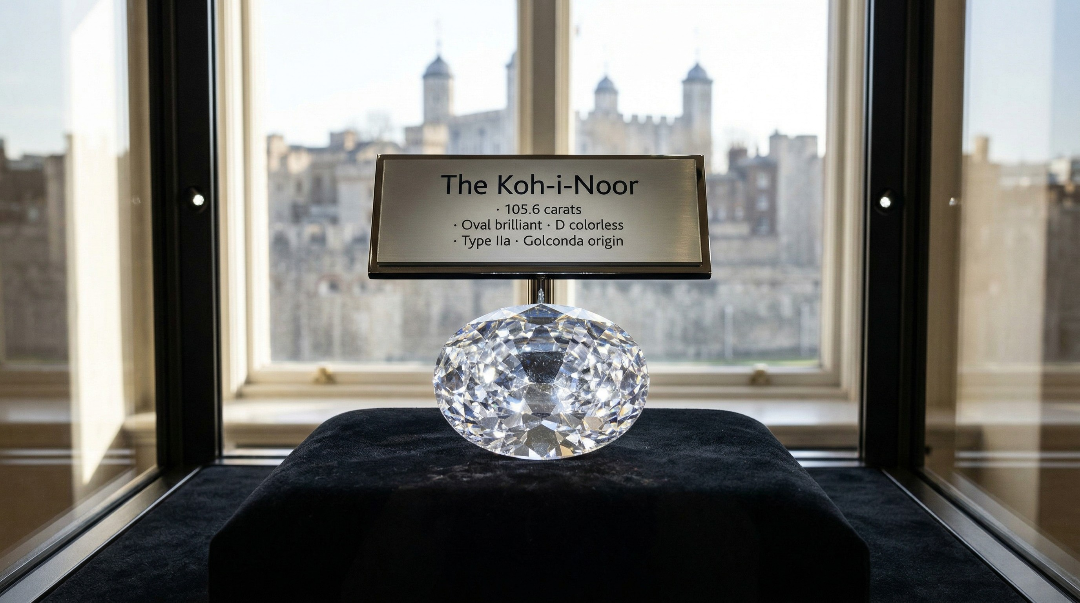
The Koh-i-Noor Mountain of Light Empire of Dispute
Diamond History
The Koh-i-Noor
Mountain of Light, Empire of Dispute
A diamond that has been seized by emperors, renamed by conquerors, recut by royal command, and claimed by three nations — still sitting in the Tower of London, still unsettled, after 700 years.
April 2026 · Alex Lexington Editorial · 7 min read
The Facts at a Glance
105.6 Carats · Colorless
186 Original Carats · Before Recut
5+ Empires Held It
3 Nations Claim · Ownership Today
Full name: Koh-i-Noor (کوہ نور) — Persian for "Mountain of Light," named by Nader Shah of Persia upon seizing it from the Mughal treasury in 1739
Cut: Oval brilliant — 66 facets. Recut in 1852 from its original Mughal rose cut by Coster Brothers of Amsterdam under Prince Albert's direction
Color: Grade D — colorless. Type IIa diamond, meaning virtually no nitrogen impurities. Among the most chemically pure diamonds ever documented
Origin: Kollur Mine, Golconda region, present-day Andhra Pradesh, India — the same ancient alluvial source as the Hope Diamond, the Florentine, and the Regent
Current holder: The British Crown — displayed in the Jewel House, Tower of London, as part of the Crown Jewels collection
Disputed by: India, Pakistan, and Afghanistan each maintain formal or informal claims to the stone's return — the most contested piece of jewelry on earth
Origins
Where It Came From
The Koh-i-Noor was mined from the Kollur mine in the Golconda region of India — the same alluvial diamond field that produced nearly every legendary stone in European royal history. Golconda diamonds are Type IIa: virtually nitrogen-free, which gives them an optical purity and light transmission that modern mine output rarely matches. The Koh-i-Noor is graded D color — as colorless as a diamond can be measured.
Its exact discovery date is unknown. What is known is that by the time the Mughal Empire consolidated power in northern India in the 1500s, the stone was already ancient. It entered written record as a treasure of extraordinary size — 186 carats in its original Mughal rose cut — passed between rulers not as jewelry but as a political instrument. Whoever held the Koh-i-Noor held a claim to sovereignty itself.
The stone was never just a diamond. It was a credential. Every conqueror who took it understood that possessing the Koh-i-Noor was a public declaration: I rule here now. For 700 years, the stone has functioned less as a gem and more as a throne.
The name it carries today was not its first. The Persians called it "Mountain of Light" — Koh-i-Noor — when Nader Shah seized it from the Mughal treasury in 1739. Before that, it had other names in other courts, none of which survived. What survived was the stone, and the pattern it established: every empire that held it eventually lost it. The Mughals lost it to Persia. Persia lost it to Afghanistan. Afghanistan lost it to the Sikhs. The Sikhs lost it to Britain. Britain still holds it — but the conversation about whether it should stay there has never been louder.

The Koh-i-Noor · 105.6 carats · Oval brilliant · D colorless · Type IIa · Golconda origin
Ownership Timeline
Seven Centuries, Five Empires
c. 1300s
Golconda, India — First Origin
Mined from the Kollur alluvial deposits in what is now Andhra Pradesh. The stone enters the treasuries of regional Hindu and later Muslim dynasties as a political asset of the highest order.
1526
The Mughal Empire — 200 Years at the Center
Babur establishes the Mughal Empire in India. The diamond becomes part of the imperial treasury, held for roughly two centuries as a symbol of dynastic legitimacy rather than personal ornamentation.
1739
Nader Shah of Persia — The Naming
Nader Shah invades Delhi and sacks the Mughal treasury. He exclaims "Koh-i-Noor!" — Mountain of Light — upon seeing the stone. The name sticks. The diamond leaves India for the first time.
1747
Afghan Dynasty — From Persia to Kabul
After Nader Shah's assassination, the diamond passes to Ahmad Shah Durrani, founder of the Durrani Empire. The stone stays in Afghan royal hands for decades — the basis of Afghanistan's modern claim.
1813
The Sikh Empire — Return to India
Shah Shuja Durrani surrenders the diamond to Maharaja Ranjit Singh. He wears it on his arm and considers it the centerpiece of the Sikh treasury. Upon his death in 1839, violent succession disputes follow.
1849
The British Crown — Treaty of Lahore
After the Second Anglo-Sikh War, the Treaty of Lahore cedes the Koh-i-Noor to Britain. Taken from ten-year-old Duleep Singh, the last Sikh emperor. Presented to Queen Victoria on February 28, 1850.
1852
The Recut — 80 Carats Lost Forever
Coster Brothers of Amsterdam recut the stone from 186 carats to 105.6 carats. Prince Albert supervises. The process takes 38 days. 43% of the mass is sacrificed. 700 years of cutting history erased.
Present
Tower of London — The Dispute Continues
The Koh-i-Noor sits in the Crown Jewels at the Tower of London. India, Pakistan, and Afghanistan all claim it. The British government maintains it was legally acquired. The stone remains — as always — unsettled.
Why It Matters
What No Other Diamond Carries
The Koh-i-Noor is not the largest diamond in the world. It is not the most expensive. It has been recut in a way that many experts consider a diminishment. And yet it remains, by almost any measure, the most important diamond on earth — because no other stone carries this much political and emotional weight simultaneously.
Three sovereign nations have active claims to it. Its ownership chain reads like a compressed history of South and Central Asian power for the last seven centuries. Every chapter of its story raises questions that have no clean answers — about ownership, about cultural patrimony, about what it means when a stone outlives every government that ever held it.
For the study of gems, the Koh-i-Noor matters because it is the clearest example of a diamond that transcended its material value to become a political instrument. Other great diamonds are admired. The Koh-i-Noor is contested. That distinction is permanent.
The Alex Lexington Design Perspective
Why We Design This Way
The images in this article are the product of design intelligence — the same process that drives every piece in the Legendary Gems series. We begin with the stone's history, its provenance, its cultural meaning, and then we ask a question that no museum display can answer: what would this stone look like if it were commissioned today, by a house that understood both its past and its possibilities?
The Koh-i-Noor is uniquely challenging as a design subject because it carries more political and emotional freight than any other gem. Any modern setting has to acknowledge that complexity. A setting that ignores the history is empty. A setting that tries to resolve the history is dishonest. The right approach is one that holds the tension.
The great jewelry houses of the world built their archives over generations. Every piece they designed, every stone they wrote about, every point of view they committed to — that accumulated record became their authority. We are building ours now.
Alex Lexington does not claim the right to set the Koh-i-Noor. No private house does. What we claim is the right to imagine it — to place it in a design context that honors both the stone and the conversation around it. These settings are expressions of a design perspective that takes history seriously, and takes craft seriously, and takes the position that imagining at this level is how a house builds its authority over time.
Design Imagination · Alex Lexington
If the Koh-i-Noor Were Worn Today
Three settings. Three ways of holding the tension between a stone's beauty and its contested history — designed by a house that believes imagination is the beginning of authority.

Setting I
The Maharaja's Reverie Pendant
Mughal Tribute · Ceremonial Grace
The most faithful homage to its Indian heritage. The 105-carat oval brilliant suspended in an open-talon 18kt white gold mounting with a graduated collar of old mine cut diamonds that reference the Golconda origin. The bail is dressed with hand-finished Mughal lattice filigree — the geometric jali patterns found in Mughal palace architecture from Agra to Lahore. A single carved jade cabochon sits at the apex of the bail, a quiet nod to the Mughal tradition of combining diamonds with jade in imperial jewelry.
The Alex Lexington take here is restraint informed by research. The Mughal courts did not set their great diamonds the way European courts did — they favored open settings that allowed light to pass through, complemented by carved hardstones and enamelwork rather than pavé. This pendant honors that tradition without reproducing it. The jali filigree is a design reference, not a replica. The jade accent is a conversation, not a costume.

Setting II
The Mountain of Light Tiara
Imperial Summit · Modern Regalia
The closest to the stone's function as a symbol of sovereignty. The Koh-i-Noor sits at the apex of a platinum tiara — the center element of a radiating fan motif that reads as a literal mountain of light. Each ray is set with graduated white diamonds on articulated stems, creating movement with every turn of the head. The base band features alternating channel-set baguettes and round brilliants blending Mughal architectural precision with Art Deco clean lines.
This is the setting that acknowledges the Koh-i-Noor's true function: it has always been worn at the summit. The radiating fan motif translates "Mountain of Light" into literal design language. The blending of Mughal geometric precision with Art Deco clarity honors both the stone's origin and the Western court that currently holds it, without choosing sides.

Setting III
The Five Empires Ring
Contested Sovereignty · Statement Power
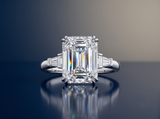
A statement ring that holds the stone's full political complexity in a single design. The Koh-i-Noor set in an architectural platinum mounting with five distinct shoulder sections — each finished in a different metalwork tradition: Mughal jali filigree, Persian arabesque, Afghan geometric carving, Sikh lotus motifs, and British laurel engraving. The sections meet at the center stone without blending — each tradition preserved, each boundary visible.
This is the most conceptually ambitious setting in the series — a piece that treats the stone's contested provenance not as a problem to solve but as a design feature to honor. The slightly off-center mounting is the design's thesis — this stone has never been settled, and the ring doesn't pretend otherwise. It is power jewelry in the truest sense: jewelry that carries a position.
Alex Lexington
alexlexington.com · Atlanta, Georgia
Read more
Gold at $4,521 and Silver at $72 — Why the Smart Move Is to Watch, Not Chase
Gold spot hit $4,521.30 today, up 2.71%. Here's why the recovery has legs — and why sitting out until Friday may be the smartest trade of the week.
Read more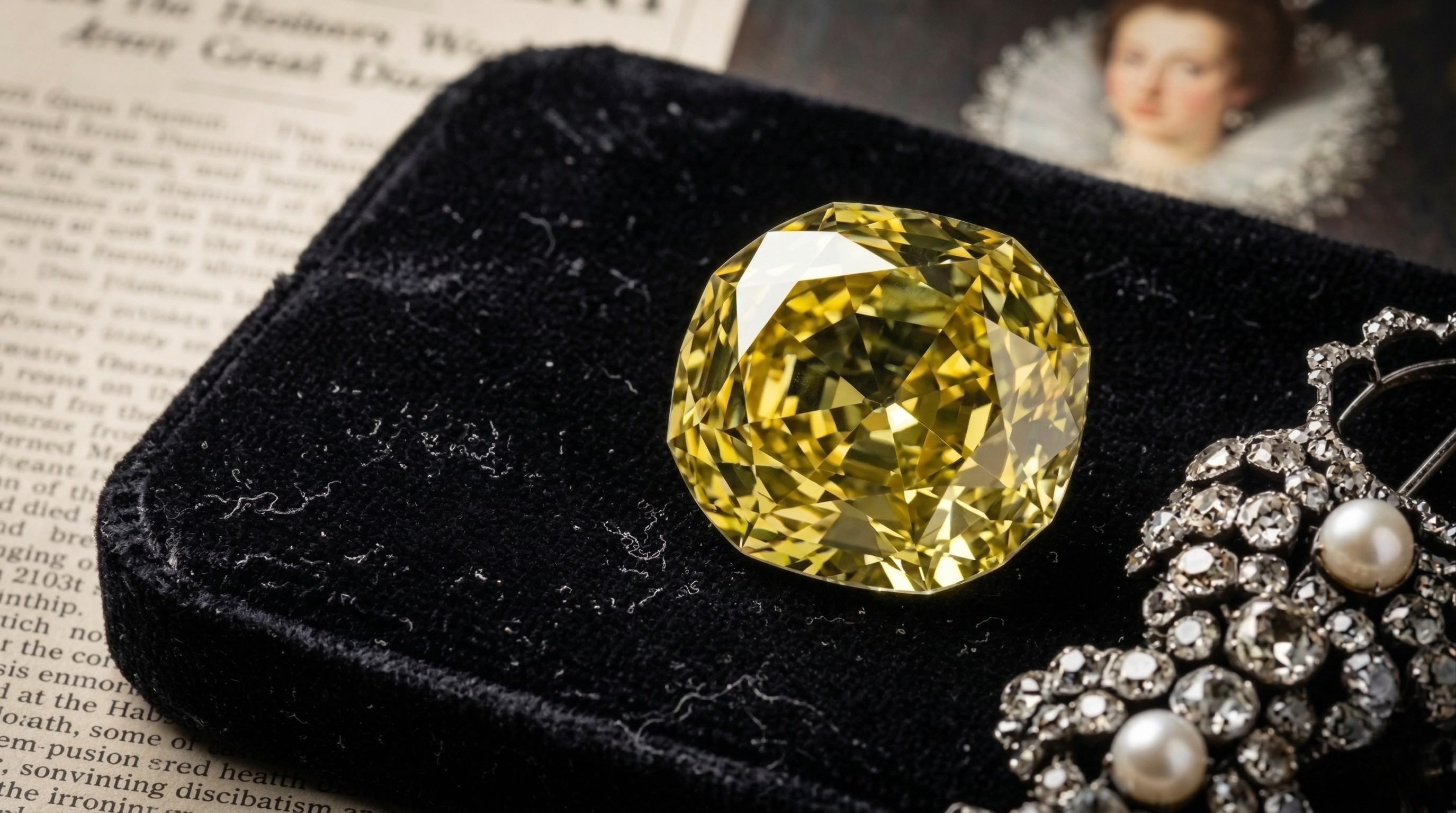
The Florentine Diamond 137 Carats of Renaissance Power
Diamond History The Florentine Diamond137 Carats of Renaissance Power A pale yellow diamond with a green whisper — held by the Medicis, crowned by the Habsburgs, lost for a century, and fou...
Read more