


Gold
—









The Florentine Diamond 137 Carats of Renaissance Power
Diamond History
The Florentine Diamond
137 Carats of Renaissance Power
A pale yellow diamond with a green whisper — held by the Medicis, crowned by the Habsburgs, lost for a century, and found in a Canadian vault in 2025. The stone that time hid.
March 2026 · Alex Lexington Editorial · 8 min read
The Facts at a Glance
137.27 Carats · Yellow-Green
126 Facets · Double Rose Cut
2 Dynasties · Medici · Habsburg
100+ Years Lost · Found Nov 2025
Full name: The Florentine Diamond — also known as the Grand Duke of Tuscany Diamond, the Tuscan Diamond, and the Austrian Yellow. Named for the Medici city that made it famous
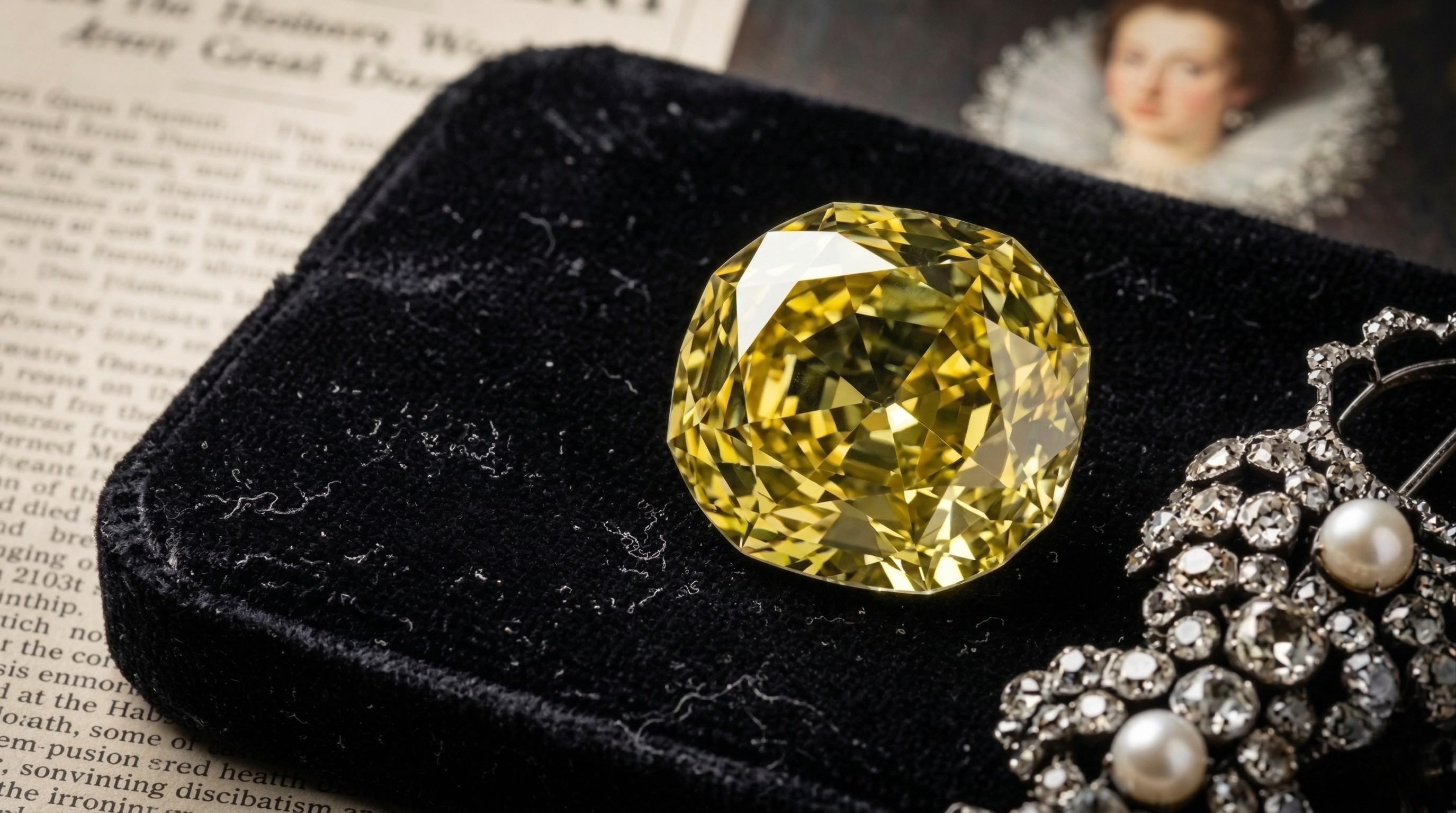
Cut: Double rose cut — 126 facets across an irregular nine-sided oval form. One of the most intricate historical cuts ever documented, with facets on both top and bottom surfaces
Color: Pale yellow with a subtle green overtone — a distinctive combination that sets it apart from other famous yellow diamonds. The green whisper is its signature
Origin: Golconda region, India — the same ancient diamond field that produced the Koh-i-Noor, the Hope Diamond, and the Regent. Likely mined in the 15th or 16th century
Current holder: The Habsburg family descendants — recovered in November 2025 from a Quebec bank vault where Empress Zita had secretly stored it during World War II
Contested by: Italy has claimed the diamond should have remained in Florence under the Treaty of Saint-Germain-en-Laye. Austria has argued it was imperial state property. The Habsburgs have maintained private ownership since 1918
Origins
Where It Came From
The Florentine Diamond was born in the Golconda region of India — the ancient alluvial fields that supplied the Western world's most extraordinary stones for centuries. Golconda was not a single mine but a network of riverbeds and shallow pits in what is now Andhra Pradesh and Telangana, where diamonds were found washed downstream from primary kimberlite sources that have never been precisely identified. Every legendary stone of the pre-18th century — the Koh-i-Noor, the Hope, the Regent — came from this region. The Florentine was among them.
What makes the Florentine immediately distinctive is its color. At 137.27 carats, it is pale yellow with a subtle green overtone — not the saturated canary of a Fancy Vivid, but something cooler and more complex. The green whisper is what separates it from the other famous yellow diamonds in history. It does not shout. It suggests. That restraint — if a diamond can be said to have restraint — has defined its character across five centuries of ownership.
The Florentine was never the biggest. Never the most colorless. Never the most publicly displayed. It was the one that the most sophisticated families in European history chose to keep — and when the world was ending around them, chose to hide. That choice tells you everything about what this stone is.
The 126-facet double rose cut is as remarkable as the stone itself. Unlike the brilliant cut that dominates modern diamond work, the double rose has no flat table facet — both the top and bottom surfaces are domed with triangular facets, creating an optical effect that is less about fire and more about a deep, rolling luminosity. The nine-sided irregular shape is unusual even among historical rose cuts. Whoever cut the Florentine was working at the absolute frontier of 15th- or 16th-century lapidary skill, and the result has never been recut or altered. What you see today is what a Renaissance master intended.

The Florentine Diamond · 137.27 carats · Double rose cut · 126 facets · Pale yellow-green · Golconda origin
Ownership Timeline
From Golconda to a Quebec Vault
c. 1400s
Golconda, India — First Origin
Mined from the alluvial diamond fields of India's Golconda region. The stone enters the gem trade at a time when India is the only known source of diamonds on earth. Its early provenance is undocumented — the first centuries of this stone's life are silence.
1657
The Medici Treasury — First Documentation
Jean Baptiste Tavernier, the French gem dealer who personally examined more legendary stones than anyone in history, records the Florentine in the possession of Grand Duke Ferdinando II de' Medici. This is the stone's first verified appearance in written record. It becomes a centerpiece of the Medici treasury in Florence — the city that will give it its name.
1737
House of Habsburg — Dynasty Transfer
When the Medici line ends, the diamond passes to Francis Stephen of Lorraine through his marriage to Empress Maria Theresa. The stone moves from Florence to Vienna and becomes Habsburg property — adorning the crown when Francis Stephen is crowned Holy Roman Emperor in 1745. It will remain in Habsburg hands for the next 280 years.
1745–1918
The Hofburg Palace — Imperial Display
For nearly two centuries, the Florentine sits in the Imperial Treasury at the Hofburg Palace in Vienna. It is the centerpiece of the Habsburg crown jewels — a symbol of dynastic continuity through wars, revolutions, and political upheaval across all of Europe. Generations of visitors see it. It is photographed, catalogued, admired. It is known.
1918
The Fall of an Empire — Into Exile
The Austro-Hungarian Empire collapses after World War I. Emperor Charles I abdicates. The Habsburg family removes the Florentine from the Imperial Treasury and takes it into exile in Switzerland. Italy claims it under the Treaty of Saint-Germain-en-Laye. Austria argues it was state property. The Inter-Allied Reparation Commission sides with the Habsburgs in 1923. And then — the diamond vanishes from public record.
1922–2025
The Century of Silence
For over 100 years, the Florentine Diamond is considered lost. Theories multiply: it was smuggled to South America, stolen during exile, recut and sold anonymously on the black market. Gem historians write its obituary. The diamond world moves on. But Empress Zita, widow of Charles I, had a different plan — and a 100-year embargo on the family secret.
Nov 2025
A Quebec Bank Vault — The Return
Habsburg descendants Simeon, Lorenz, and Karl von Habsburg-Lothringen announce that the Florentine has been in a Quebec bank safe deposit box since World War II — placed there by Empress Zita when the family relocated to Canada. The stone is intact. Undamaged. 83 years in a drawer, while the entire world wrote stories about where it had gone. Negotiations are underway with the Quebec National Museum of Fine Arts for public exhibition.
Why It Matters
What the Florentine Teaches Us
The Florentine Diamond's significance is not its size, though 137.27 carats places it among the world's largest historical diamonds. It is not its color, though the pale yellow-green is one of the most distinctive hues in gemological record. What makes the Florentine matter is what it represents at the intersection of art, power, and survival.
Two of the most powerful families in European history — the Medicis and the Habsburgs — chose this stone as their defining jewel. The Medicis, who essentially invented the concept of patronage and cultural power as political strategy, kept the Florentine at the center of their treasury. The Habsburgs, who held the longest continuous dynasty in modern European history, crowned an emperor with it. When the empire fell, the stone was the thing they saved.
And then the most extraordinary chapter of all: a century of deliberate concealment. Empress Zita did not lose the Florentine. She hid it — with a 100-year embargo, a family secret kept across generations, while the rest of the world assumed the worst. The Florentine's story is not about a diamond that vanished. It is about a family that chose silence over spectacle, patience over publicity, and a Canadian bank vault over the front pages. In an age when everything is immediately visible, the Florentine spent a hundred years being deliberately invisible. That might be the most remarkable thing about it.
The Alex Lexington Design Perspective
Why We Design This Way
The Florentine Diamond is the inaugural subject in the Legendary Gems series because it embodies the Alex Lexington approach to design thinking: start with the history, understand the provenance, respect the complexity, and then imagine forward. Every setting concept in this article begins with a fact about the stone — its Medici origins, its Habsburg coronation, its century in hiding — and translates that fact into a design decision.
The Florentine is particularly interesting as a design subject because of its double rose cut. The 126-facet form has never been altered, which means any modern setting has to work with a stone shape that no contemporary jeweler would encounter in practice. The double rose does not behave like a brilliant. It does not throw fire the same way. What it does is glow — a deep, rolling luminosity that rewards close attention rather than distant spectacle. The settings in this article are designed with that optical quality in mind.
The great jewelry houses of the world built their archives over generations. Every piece they designed, every stone they wrote about, every point of view they committed to — that accumulated record became their authority. We are building ours now.
What you see below is design intelligence applied to history. Three settings, each one a different reading of the Florentine's story. Not renderings of jewelry we intend to produce — renderings of how we think about stones at this level. This is how a house establishes its perspective: by imagining publicly, at the highest level it can reach, and building a body of work that compounds over time.
Design Imagination · Alex Lexington
If the Florentine Were Set Today
Three settings. Three readings of a stone that survived two dynasties and a century of silence — designed by a house that believes imagination is the beginning of authority.

Setting I
The Medici Pendant
Renaissance Authority · Florentine Craft
The most direct homage to the stone's Italian chapter. The 137-carat double rose cut Florentine set in an 18kt yellow gold pendant mounting with Renaissance-era open-back construction that allows light to pass through both surfaces of the double rose cut — essential for a stone that was designed to be seen in candlelight. The bail features Florentine granulation work: tiny spheres of gold fused to the surface in patterns inspired by Etruscan jewelry techniques that the Medici revived during the Renaissance. A border of step-cut peridots in graduated green tones echoes the stone's distinctive green overtone.
The Alex Lexington take here is material honesty. The double rose cut was made to glow, not to fire — it predates the brilliant cut by centuries. Any setting that treats it like a modern stone misunderstands it. The open-back construction and yellow gold let the stone do exactly what its original cutter intended. The peridot border is a design conversation with the green overtone, not competition with it.

Setting II
The Habsburg Crown Brooch
Imperial Stability · Architectural Precision
The stone's longest chapter was Habsburg — nearly three centuries of imperial display. This brooch translates that era into wearable form. The Florentine mounted in a platinum and white gold architectural setting inspired by the Hofburg Palace ceiling vaults where it was displayed. Radiating from the center stone, eight symmetrical arms set with graduated old European cuts terminate in tiny laurel leaf finials — the Habsburg symbol of imperial authority. The mounting includes micro-engraved text on the reverse: the coordinates of the Hofburg Treasury and the Quebec bank vault.
This is the setting that honors the stone's political weight. The Habsburgs did not wear the Florentine — they displayed it as a symbol of continuity. The brooch format allows the piece to function the same way: visible, architectural, meant to carry meaning from across a room. The hidden coordinates on the reverse are the Alex Lexington signature — a private layer of information in a public piece.

Setting III
The Century of Silence Ring
Hidden Survival · Modern Revival
The most conceptually ambitious setting — one that tells the Florentine's most extraordinary chapter. The stone set in a minimal platinum bezel with a hinged outer shell of brushed white gold that closes to completely conceal the diamond. When open, the Florentine sits exposed. When closed, the exterior presents as a smooth, featureless capsule. The hinge mechanism is a Swiss watchmaking complication, invisible from the exterior. The interior of the closed shell is lined with sapphire crystal, preserving the stone in a sealed environment — a jeweled time capsule you can wear.
This is the setting that takes the Florentine's most remarkable fact and turns it into a design principle. For a century, this diamond was hidden in plain sight — in a drawer, in a vault, in a country nobody suspected. The ring does the same thing. Closed, it is anonymous. Open, it reveals the most historically significant yellow diamond on earth. It is, in the most literal sense, jewelry about the act of concealment and revelation. That is what the Florentine taught us.
Alex Lexington
alexlexington.com · Atlanta, Georgia
Read more
The Koh-i-Noor Mountain of Light Empire of Dispute
Diamond History The Koh-i-NoorMountain of Light, Empire of Dispute A diamond that has been seized by emperors, renamed by conquerors, recut by royal command, and claimed by three nations — ...
Read more
The Taylor-Burton 69 Carats of Hollywood Love and Auction Drama
Diamond History The Taylor-Burton69 Carats of Hollywood Love and Auction Drama A 241-carat rough from South Africa, cut by Harry Winston, au...
Read more