


Gold
—






The Taylor-Burton 69 Carats of Hollywood Love and Auction Drama
Diamond History
The Taylor-Burton
69 Carats of Hollywood Love and Auction Drama
A 241-carat rough from South Africa, cut by Harry Winston, auctioned at Parke-Bernet, bought by Richard Burton over the phone from a hotel in England, worn by Elizabeth Taylor at the Oscars, and sold to build a hospital in Botswana. No diamond in history has lived a more cinematic life.
April 2026
·
Alex Lexington Editorial
·
8 min read
The Facts at a Glance
69.42
Carats · Pear Shape
$1.05M
1969 Auction · Parke-Bernet
241
Carats Rough · Premier Mine
30
Days Per Year · Allowed to Wear
Full name: The Taylor-Burton Diamond — originally named the "Cartier Diamond" at auction, renamed when Richard Burton purchased it from Cartier the following day for Elizabeth Taylor
Cut: Pear brilliant — cut by Harry Winston and master cleaver Pastor Colon Jr. from a 241-carat rough over six months of study. Later recut to 68 carats by Robert Mouawad in 1980
Color & Clarity: E-F color (near colorless), Internally Flawless — an exceptional combination at this carat weight, graded by the Gemological Institute of America
Origin: Premier Mine, South Africa — the same mine that produced the Cullinan Diamond. Discovered in 1966 as a 241-carat rough
Current holder: Robert Mouawad of Mouawad Jewelers — purchased in 1979, recut to 68 carats in 1980, held privately for over 45 years
Famous for: The most cinematic diamond in history — a Hollywood love story, a legendary auction, an Oscar night, and a philanthropic farewell
Origins
Where It Came From
In 1966, a 241-carat rough diamond was pulled from the Premier Mine in South Africa — the same mine that had produced the Cullinan Diamond six decades earlier. The rough was acquired by Harry Winston, who handed it to his master cleaver Pastor Colon Jr. for evaluation. What followed was six months of study. The markings on the rough were drawn, erased, and redrawn multiple times before anyone touched it with a blade. The stakes were simple: at this size and quality, a wrong cut would destroy tens of millions of dollars in potential value. A right cut would create one of the great diamonds of the modern era.
The right cut won. Winston and Colon produced a 69.42-carat pear-shaped brilliant — E-F color, Internally Flawless — a stone of extraordinary optical purity. At nearly 70 carats in a pear shape with those grades, it was immediately one of the finest large diamonds in existence. The pear cut was deliberate: it maximizes light return and visual drama while allowing the viewer's eye to travel the length of the stone. At this size, that journey is considerable.
Before Burton. Before Taylor. Before the auction, the phone call, and the Oscars — there was a man in a room with a 241-carat rough and a marking pencil, deciding where to cut. Six months of that. Everything that happened after depended on those marks being right.
The first buyer was Harriet Annenberg Ames, sister of billionaire publisher Walter Annenberg. She purchased the finished stone from Winston but almost immediately regretted the decision — not because of the diamond, but because of what wearing it meant. She later described keeping her gloves on in public, terrified someone would see it. The diamond sat in a bank vault for two years. In 1969, she consigned it to auction at Parke-Bernet in New York. What happened next turned a very fine diamond into the most famous gem of the twentieth century.

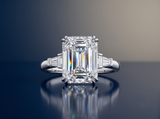
The Taylor-Burton Diamond · 69.42 carats · Pear brilliant · E-F color · Internally Flawless · Premier Mine, South Africa
Ownership Timeline
From a South African Mine to an Oscar Stage
1966
Premier Mine, South Africa — Discovery
A 241-carat rough diamond is recovered from the Premier Mine. Harry Winston acquires it. His master cleaver Pastor Colon Jr. spends six months studying the stone before making the first cut. The result: a 69.42-carat pear-shaped brilliant of extraordinary quality.
1967
Harriet Annenberg Ames — The Reluctant Owner
Ames, sister of billionaire Walter Annenberg, purchases the finished diamond. She wears it once. She finds herself keeping her gloves on in public, afraid someone will see it. It goes into a bank vault, where it stays for two years. She later calls the experience of owning it "positively cringing."
Oct 1969
Parke-Bernet Auction — The Night Everything Changed
October 23, 1969. Lot #133 at Parke-Bernet, New York. Bidding opens at $200,000. By $500,000, nine bidders remain. By $650,000, only two. Richard Burton's representative drops out at $1,000,000. Cartier's Robert Kenmore wins at $1,050,000 — the highest price ever paid for a diamond at auction. Cartier names it the "Cartier Diamond." That name lasts exactly one day.
Oct 1969
Richard Burton — The Phone Call
The next morning, October 24, Burton calls Cartier from a pay phone in an English hotel. He instructs his lawyer to acquire the diamond regardless of price. He pays $1.1 million — $50,000 over the auction hammer price. The stone is renamed the Taylor-Burton Diamond. Six thousand people per day line up at Cartier in New York and Chicago just to see it before it leaves.
1969
The Ring That Became a Necklace
The diamond arrives set in a platinum ring. Taylor finds it too heavy to wear. Oscar Heyman, working with Cartier, redesigns it as a custom necklace in six days. Cost: $80,000. The pendant is engineered to nestle precisely in Taylor's décolletage. Lloyd's of London insures it for $1 million — with a condition: she can only wear it in public 30 days per year, with armed guards.
Apr 1970
The 42nd Academy Awards — The Defining Moment
Elizabeth Taylor presents the Best Picture Oscar wearing the Taylor-Burton Diamond on live television. Millions watch. The diamond is broadcast into homes across the world. It becomes, in a single evening, the most recognized piece of jewelry on earth. No museum display, no royal coronation, no auction catalogue could have achieved what that one television appearance did.
1979
The Farewell — Sold to Build a Hospital
After her second divorce from Burton, Taylor sells the diamond to New York jeweler Henry Lambert for nearly $5 million. Part of the proceeds fund the construction of a hospital in Botswana — the country where Taylor and Burton had remarried in 1975. The diamond that began as a love story ends as an act of generosity. The appreciation: roughly 5x in ten years.
Present
Mouawad Collection — Private Holdings
Robert Mouawad purchases the diamond from Lambert in 1979 and recuts it to 68 carats in 1980. It has remained in the Mouawad private collection for over 45 years — one of the longest single-owner periods in the stone's history. It has not been publicly exhibited or offered for sale since.
Why It Matters
The Diamond That Changed What Fame Means
Before the Taylor-Burton Diamond, famous gems earned their status through centuries of royal ownership, political conquest, or institutional display. The Hope Diamond sat in the Smithsonian. The Koh-i-Noor sat in the Tower of London. The Cullinan sat in the Crown Jewels. Fame was earned through time and sovereignty.
The Taylor-Burton changed that equation permanently. A diamond discovered in 1966 became the most famous gem in the world by 1970 — not because an empire claimed it, but because a movie star wore it to the Oscars. It proved that celebrity could replace royalty as the defining provenance for a great stone. That shift has shaped the diamond market ever since. Every major auction house, every luxury jeweler, every collector who tracks celebrity ownership of important stones is operating in a world the Taylor-Burton Diamond created.
But the Taylor-Burton also matters for a reason that gets overlooked: the ending. Taylor did not keep it. She sold it — and used the money to build a hospital. The most famous romantic gesture in modern jewelry history ended as an act of philanthropy. That arc — from love story to public good — is what separates the Taylor-Burton from every other celebrity diamond. It had a third act, and the third act was generous.
The Alex Lexington Design Perspective
Why We Design This Way
The Taylor-Burton Diamond presents a design challenge unlike any other stone in this series. The Florentine was about Renaissance craft. The Koh-i-Noor was about political sovereignty. The Taylor-Burton is about romance and spectacle — and designing for spectacle requires a different kind of restraint. The temptation is to match the drama of the stone's story with drama in the setting. The better approach is the opposite: let the stone's story carry the weight, and let the metalwork serve it.
The original Oscar Heyman necklace setting understood this perfectly. It did not compete with the diamond. It positioned it. Six days of master craftsmanship devoted to the question of placement — where the stone would sit, how it would move, how television lights would hit it. That is design thinking at the highest level: not decoration, but engineering in service of a single moment.
The great jewelry houses of the world built their archives over generations. Every piece they designed, every stone they wrote about, every point of view they committed to — that accumulated record became their authority. We are building ours now.
The three settings below each respond to a different chapter of the Taylor-Burton's story. One honors the Hollywood moment. One honors the relationship. One honors the farewell. Together, they represent the Alex Lexington position that a stone's emotional history is as much a design material as platinum or gold.
Design Imagination · Alex Lexington
If the Taylor-Burton Were Set Today
Three settings. Three chapters of the most cinematic diamond in history — designed by a house that believes a stone's emotional history is as important as its carat weight.

Setting I
The Oscar Night Choker
Hollywood Spectacle · Red Carpet Authority
The most direct homage to the diamond's defining moment: April 7, 1970, the 42nd Academy Awards. The 69-carat pear brilliant suspended from a platinum and white gold choker designed for stage presence. The band is a graduated ribbon of channel-set baguette diamonds that catches light in a continuous horizontal line — engineered to read on camera from the back of a room. The pendant mounting is a minimal open-prong setting that maximizes the stone's exposure while allowing full light return through the pavilion. Two pear-shaped drops flank the center stone, echoing its silhouette at reduced scale.
The Alex Lexington take here is performance engineering. Oscar Heyman's original necklace was designed for one specific purpose: to look extraordinary on television. This choker takes the same principle and updates it for today's red carpet — where the distance between camera and subject is measured in inches, not feet, and where the light source is LED, not incandescent. Every design decision serves the question: how does this read on screen?

Setting II
The Love Letter Ring
Romantic Declaration · Private Devotion
A return to the stone's original form: a ring. But not the simple platinum three-stone that Taylor found too heavy. This is a sculptural cocktail ring in 18kt rose gold — the warm metal a deliberate contrast to the stone's icy colorlessness. The shanks are split and twisted, referencing the two marriages between Burton and Taylor: parallel lines that separate and rejoin. The pear-shaped diamond is set north-south with an asymmetric halo of pink sapphires on one side and colorless diamonds on the other — the warmth and the brilliance, the passion and the clarity, held in permanent tension.
This is the setting that treats the Taylor-Burton as a love story rather than an auction record. The split shank is the design's thesis — two paths that keep meeting. Burton wrote to Taylor: "I am forever punished by the gods for being given the fire and trying to put it out. The fire, of course, is you." The rose gold and the pink sapphires carry the heat of that sentence. The colorless diamond carries the clarity that always arrived too late.

Setting III
The Botswana Tiara
Philanthropic Legacy · Graceful Departure
The setting that honors the diamond's final chapter — the one nobody expected. When Taylor sold the Taylor-Burton, she used the proceeds to help build a hospital in Botswana. This tiara translates that generosity into wearable form. The 69-carat pear is set inverted at the center of a platinum and yellow gold bandeau — the stone pointing down, a deliberate reversal of the traditional upward orientation. Flanking it, graduated pear and marquise diamonds form an organic, branching pattern inspired by the acacia trees of the Botswana landscape. The metalwork transitions from platinum at the center to 18kt yellow gold at the terminals — a material metaphor for the stone's journey from Hollywood cool to African warmth.
This is the most emotionally complex setting in the series — a piece about letting go. The inverted pear is the design's key gesture: it is a stone in the act of departure, suspended rather than displayed. Most tiaras are about display and authority. This one is about grace and release. Taylor's decision to sell the most famous diamond in the world and use the money for a hospital is, in our estimation, the most interesting jewelry decision of the twentieth century. This tiara is our attempt to honor that decision.
Alex Lexington
alexlexington.com · Atlanta, Georgia
Read more
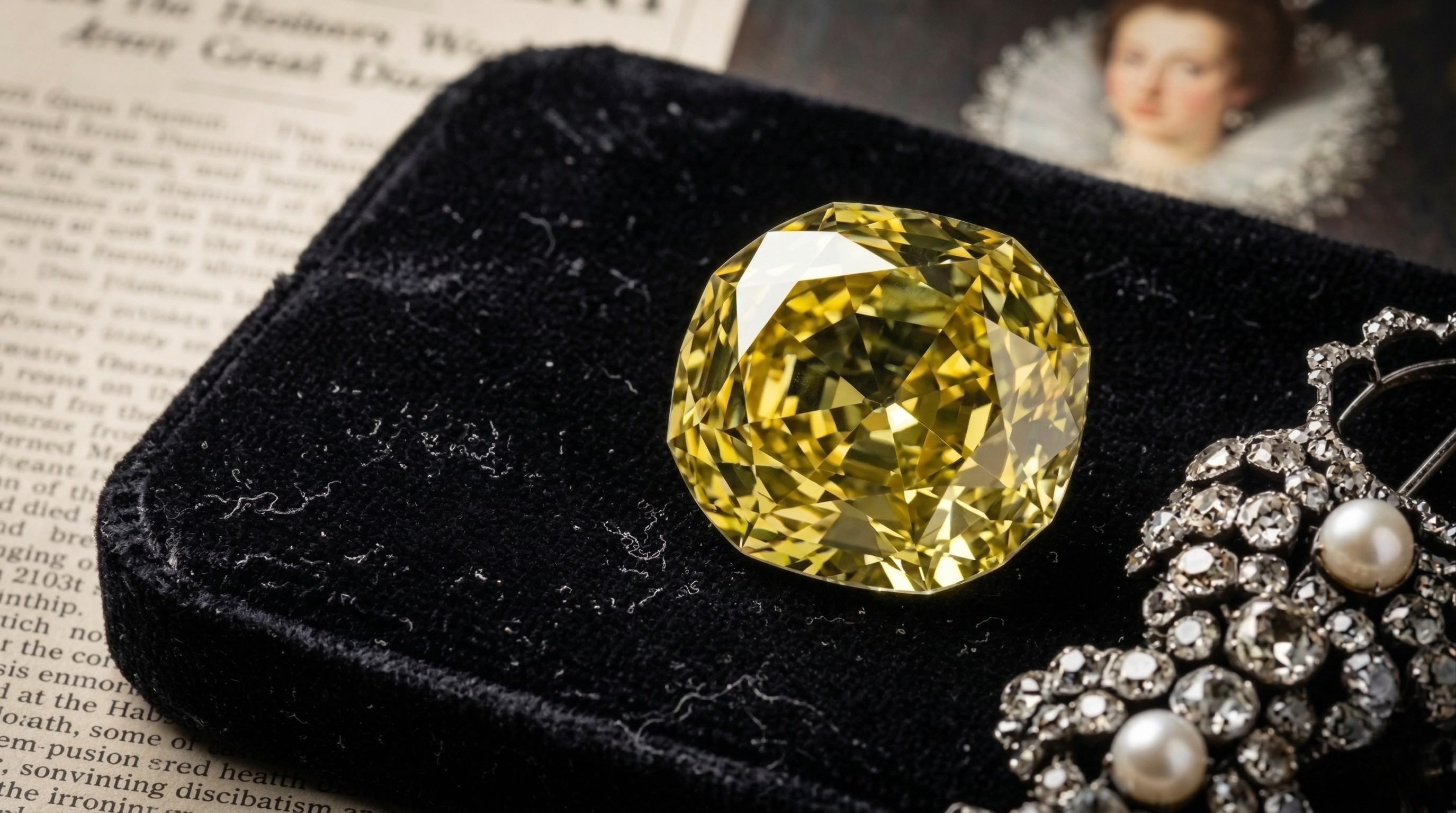
The Florentine Diamond 137 Carats of Renaissance Power
Diamond History The Florentine Diamond137 Carats of Renaissance Power A pale yellow diamond with a green whisper — held by the Medicis, crowned by the Habsburgs, lost for a century, and fou...
Read more
The Hope Diamond 45 Carats of Curse, Crown, and the Reddest Glow in Gemology
Diamond History The Hope Diamond45 Carats of Curse, Crown, and the Reddest Glow in Gemology Pulled from a Golconda riverbed, sold to Louis XIV, stolen during a revolution, recut in the dark...
Read more